Air Force Direct Commission Programs Explained
Most Air Force officers earn their commission through ROTC, the Academy, or nine weeks at OTS in Maxwell, Alabama. A much smaller group skips that pipeline entirely. Physicians, attorneys, and chaplains can join as officers based on credentials they already hold, entering through a program called direct commission. The rules, timelines, and commitments are different from every other path into the officer corps.
What Direct Commission Actually Is
The standard officer commissioning path assumes you’re building military skills from scratch. ROTC and OTS exist to turn civilians into officers. Direct commission works from the opposite premise: you’re already a professional in a field the Air Force cannot produce internally in a reasonable timeframe.
A doctor takes years of medical school and residency to practice. An attorney needs law school and a bar license. A chaplain requires ordination and formal theological education. The Air Force can’t develop those skills the way it develops cyber analysts or logistics officers. So instead, it commissions qualified professionals directly into the officer corps.
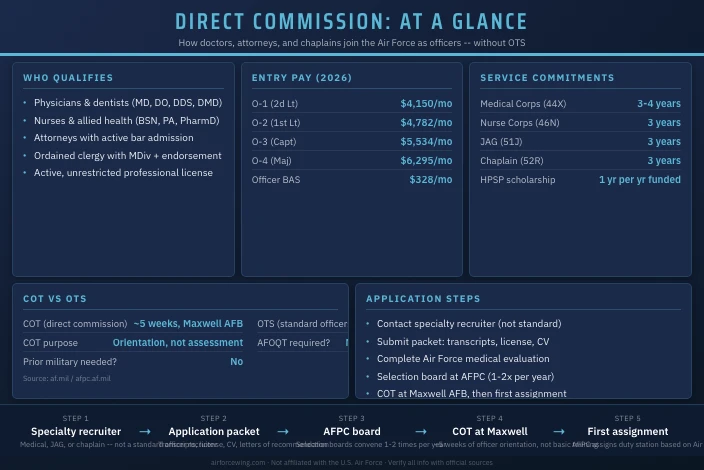
That doesn’t mean no training. Direct commission officers attend Commissioned Officer Training (COT) at Maxwell AFB, Alabama, roughly five weeks of officer orientation. COT covers Air Force customs, the Uniform Code of Military Justice, leadership fundamentals, and the Air Force Fitness Assessment. It’s not basic training or OTS. The program is designed for people who are already mid-career professionals, not for building military bearing from the ground up.
The Three Direct Commission Categories
The Air Force uses direct commission for three professional fields. Each has different credential requirements and a different career structure once you commission.
Medical and Healthcare Professionals
The Air Force Medical Service is the largest user of direct commission. The program brings in licensed physicians, dentists, nurses, pharmacists, clinical psychologists, physician assistants, physical therapists, and other allied health specialists. Together they make up four officer corps.
| AFSC | Corps | Professional Degree Required |
|---|---|---|
| 44X | Medical Corps | MD or DO |
| 46N | Nurse Corps | BSN minimum; MSN/DNP for some roles |
| 48X | Dental Corps | DDS or DMD |
| 43X | Biomedical Sciences Corps | Varies by specialty (PA, pharmacist, clinical psychologist, etc.) |
Every medical direct commission applicant must hold an active, unrestricted state license. The application goes through a separate Air Force medical recruiting channel, not the standard officer recruiter. A selection board at Air Force Personnel Command reviews packets, which typically include transcripts, proof of licensure, a CV, letters of recommendation, and results from a military physical examination.
Entry grade depends on your specialty and years of post-degree experience. A newly licensed RN typically enters at O-1 (Second Lieutenant). A physician with several years of post-residency practice may enter at O-3 (Captain). The Air Force applies a standardized formula to each case, and your recruiter will confirm your grade before you sign anything.
One alternative for students still in training: the Health Professions Scholarship Program (HPSP). HPSP pays tuition and fees through medical, dental, or nursing school in exchange for one year of active duty service per year of scholarship, with a three-year minimum. Recipients commission as officers while still enrolled and complete COT during a school break. For someone staring down $250,000 or more in projected school debt, the math is worth running before dismissing it.
Legal Officers (JAG)
Air Force Judge Advocate General (JAG) officers handle the full range of military law, courts-martial, legal assistance to servicemembers and families, contract law, international law, and direct advice to commanders on legal matters. The single AFSC in this field is 51J Judge Advocate.
To qualify:
- Juris Doctor (JD) from an ABA-accredited law school
- Active bar membership in good standing in at least one U.S. state or territory
- U.S. citizenship
- Meet Air Force age and medical standards (typically commissioned before age 42)
No prior military experience is required. The commissioning path is direct commission only. OTS, ROTC, and the Academy are not entry routes into the JAG Corps.
Most JAG officers enter at O-1 (Second Lieutenant). Applicants with prior active duty service or exceptional credentials may enter at a higher grade, but entry above O-3 is rare for initial commissions.
The work is diverse in a way that most civilian law firms aren’t. One assignment might mean prosecuting a general court-martial. The next could be deployed, advising on rules of engagement under international law. The third might involve reviewing a contract worth hundreds of millions of dollars. No other legal career offers that range at the same career stage.
Chaplains
The 52R Chaplain AFSC exists for ordained clergy of all faith traditions. Chaplains are officers, but they’re non-combatants under the Geneva Conventions, carry no weapons, and provide ministry and pastoral counseling to Airmen and their families across the full religious spectrum.
Chaplain commission requirements:
- Bachelor’s degree
- Graduate theological degree (Master of Divinity or equivalent, minimum 72 graduate semester hours in theology or religious studies)
- Ecclesiastical endorsement from a recognized religious organization
- Two years of post-graduate professional ministry experience
- U.S. citizenship and Air Force physical standards
The endorsement requirement is what makes chaplaincy different from other direct commissions. You must have an endorsing body, your denomination, religious organization, or similar entity, that will vouch for your credentials and theological standing. The Air Force does not grant exceptions to this requirement.
Most chaplains enter at O-1 (Second Lieutenant). Assignment variety is significant: base chapels, deployed support for combat units, special operations force support, and advising commanders on the religious and moral climate of their units.
Pay at Entry
Direct commission officers receive the same basic pay as any other officer at the same grade and years of service. The 2026 figures by grade:
| Grade | Title | Monthly Base Pay (under 2 years) |
|---|---|---|
| O-1 | Second Lieutenant | $4,150 |
| O-2 | First Lieutenant | $4,782 |
| O-3 | Captain | $5,534 |
| O-4 | Major | $6,295 |
| O-5 | Lieutenant Colonel | $7,295 |
Basic pay is only one part of the compensation package. Officers also receive Basic Allowance for Housing (BAH), which varies by duty station and dependent status, and Basic Allowance for Subsistence (BAS) at $328.48 per month. TRICARE health coverage has no enrollment fee and no copay on active duty.
Medical and dental officers qualify for special pays in addition to base pay: Variable Special Pay, Board Certification Pay, and Incentive Special Pay. These amounts vary by specialty and change periodically, but they can add meaningful income above the base figures shown above. Your recruiter will have current special pay rates for your specific specialty.
Service Commitments
Direct commission is not a short-term trial. Typical initial active duty obligations:
- Medical and Dental Corps (44X, 48X): 3-4 years, depending on specialty
- Nurse Corps (46N): 3 years
- Biomedical Sciences Corps (43X): varies by specialty
- JAG (51J): 3 years
- Chaplain (52R): 3 years
Officers who receive graduate specialty training, residency funding, or scholarship assistance from the Air Force take on additional obligations proportional to that investment. A physician who completes a funded specialty residency after commissioning, for example, will owe additional service beyond the baseline commitment. The contract will specify the exact terms.
The HPSP scholarship incurs one year of service per year of scholarship, minimum three years, starting after graduation and licensure.
How the Application Process Works
Direct commission application timelines are longer than most people expect. From initial recruiter contact to a selection board decision, plan for several months.
What Makes Direct Commission Different from OTS
The distinction worth understanding before you apply is this: OTS selects candidates partly on leadership potential because the Air Force is betting on what you’ll become. Direct commission selects on what you’ve already demonstrated.
An OTS candidate needs a strong AFOQT score, a competitive GPA, extracurricular leadership experience, and a good interview. A direct commission applicant needs verified credentials, licensure in good standing, and a specialty the Air Force currently needs.
That also means the application is credential-driven rather than test-driven. There’s no AFOQT requirement for medical officers or chaplains. JAG officers don’t take the AFOQT either. The bar exam and your law degree are the screening mechanism. Your medical license and specialty training are what the Air Force is vetting.
One practical consequence: the Air Force’s demand for specific specialties changes. Emergency medicine and psychiatry may be in high demand one cycle and less so the next. Contact a recruiter with current information about open slots before assuming your specialty is being actively recruited.
Is It Right for You
Direct commission appeals to licensed professionals who want stable federal employment, clinical or legal variety they can’t access in private practice, potential public service loan forgiveness through PSLF (which applies to military service), and the structure of officer life without spending years in a traditional commissioning pipeline.
The honest tradeoff is the same as any military commitment: you move where the Air Force sends you, typically on a two-to-four-year rotation cycle, and your schedule belongs to the mission when it needs to. For some people, that’s an acceptable cost. For others, it’s the decisive factor.
Physicians comparing direct commission to private practice will find the base pay doesn’t match peak private earnings. The total package, housing allowance, healthcare, retirement, and potential for loan forgiveness, changes the comparison, but it doesn’t close the gap entirely. The financial case is strongest for people early in their careers, before private practice income is well-established.
For the full picture of how direct commission fits into the broader officer entry structure, the paths to serve guide covers every commissioning route the Air Force offers. Officer career profiles for each direct commission field are at Air Force medical careers, Air Force legal careers, and Air Force chaplain careers.
For medical professionals specifically, the Air Force Medical Direct Commission guide covers the healthcare corps in more depth, including HPSP details and the clinical realities of military practice. A broader look at what officer service entails, pay, training, promotion, and daily responsibilities, is in Air Force officer vs enlisted.
This site is not affiliated with the U.S. Air Force or any government agency. Verify all information with official Air Force sources before making enlistment or career decisions.