Air Force Cyber vs Communications AFSC: What's the Difference
Both career fields deal with technology. Both require ASVAB scores above what most other jobs demand. Both can lead to high-paying civilian careers. So when a recruiter lists 1B4X1 Cyber Warfare Operations and 3D1X2 Cyber Transport Systems in the same breath, it’s easy to assume they’re basically the same thing. They’re not. The missions are different, the daily work is different, and the clearance requirements are different enough to change your career trajectory from the start.
What Cyber AFSCs Actually Do
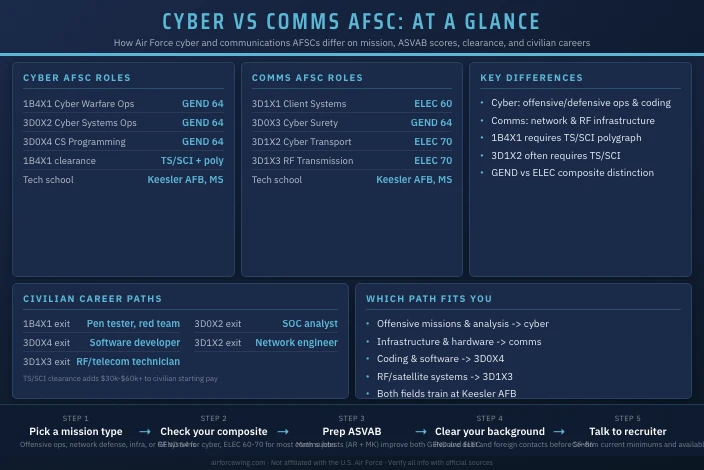
Air Force cyber encompasses three enlisted AFSCs: 1B4X1, 3D0X2, and 3D0X4. The common thread is that the mission is offensive or defensive in nature, these Airmen operate against adversary networks or protect Air Force systems from attack.
1B4X1 Cyber Warfare Operations is the most operationally intense role in the Air Force’s enlisted cyber career group. These Airmen plan and execute missions in cyberspace under U.S. Cyber Command, which means working against adversary networks, not just managing Air Force ones. The mission is classified, the clearance requirement runs to Top Secret/SCI with a Counterintelligence Scope Polygraph, and the total pipeline from enlistment to first operational assignment typically runs 12 to 18 months.
3D0X2 Cyber Systems Operations is the Air Force’s network defense and systems administration role. These Airmen manage servers, operating systems, and classified enterprise networks, the platforms that support Air Force missions worldwide. The work is less operationally focused than 1B4X1 but more analytically intensive than most IT jobs. A Secret clearance is the standard entry requirement.
3D0X4 Computer Systems Programming is exactly what it sounds like: writing and maintaining software for Air Force systems. These Airmen write code, test applications, and support mission-critical software environments. It carries a lighter clearance burden than 1B4X1 at most entry assignments and is one of the only enlisted paths in the Air Force where software development is the primary duty.
All three cyber AFSCs train at Keesler AFB, Mississippi.
What Communications AFSCs Actually Do
The Communications and Information career group, the 3D series: is infrastructure. These Airmen build, install, and maintain the networks, radio systems, and IT endpoints that every other Air Force mission depends on. The work is more engineering and operations-focused than offensive or defensive cyber.
Four enlisted AFSCs make up this group:
- 3D1X2 Cyber Transport Systems: builds and maintains the enterprise network backbone (switches, routers, voice/data/video circuits) connecting bases and deployed units worldwide
- 3D1X3 RF Transmission Systems: installs and operates ground radio and satellite systems for units where fiber and landlines aren’t an option
- 3D1X1 Client Systems: configures and supports base computers, printers, and user accounts; the most accessible entry point in the group
- 3D0X3 Cyber Surety: audits Air Force networks for compliance with DoD security standards and manages access controls
The job that causes the most confusion is 3D1X2 Cyber Transport. Its name sounds like a cyber role, and its ELEC 70 ASVAB requirement rivals the hardest thresholds in the cyber career group. But the mission is network infrastructure engineering, not cyberspace operations. There’s no offensive mission here, you’re building and sustaining the pipes that carry classified traffic, not attacking or defending what flows through them.
All four communications AFSCs also train at Keesler AFB, MS, home of the 81st Training Wing.
Side-by-Side Comparison
| Factor | Cyber (1B4X1, 3D0X2, 3D0X4) | Communications (3D1X2, 3D0X3, 3D1X1, 3D1X3) |
|---|---|---|
| Mission type | Offensive/defensive cyber ops, network security, software dev | Network infrastructure, RF/satellite systems, IT support, security compliance |
| ASVAB composite | GEND 64 (all three) | ELEC 60-70 or GEND 64 |
| Clearance minimum | Secret (3D0X2, 3D0X4); TS/SCI + poly (1B4X1) | Secret (all); TS/SCI for 3D1X2 |
| Primary work focus | Network operations, offensive missions, coding | Hardware installation, RF systems, IT support, compliance auditing |
| Tech school location | Keesler AFB, MS | Keesler AFB, MS |
| Tech school length | 66-70 days (1B4X1 longer with advanced training) | 50-136 days depending on AFSC |
| Civilian career path | Pen tester, security analyst, software developer, federal cyber | Network engineer, RF technician, IT analyst, information security |
ASVAB Score Requirements
The score thresholds are close enough to create confusion, but they test different things.
Cyber jobs lean on the GEND composite: Word Knowledge, Paragraph Comprehension, Arithmetic Reasoning, and Mathematics Knowledge. A GEND 64 is the floor for all three cyber AFSCs. That composite weights verbal reasoning alongside math, it selects for candidates who can analyze problems and communicate findings, not just configure hardware.
Communications jobs pull from both ELEC and GEND depending on the role:
| AFSC | Composite | Minimum |
|---|---|---|
| 3D1X1 Client Systems | ELEC | 60 |
| 3D0X3 Cyber Surety | GEND | 64 |
| 3D1X2 Cyber Transport Systems | ELEC | 70 |
| 3D1X3 RF Transmission Systems | ELEC | 70 |
The ELEC composite swaps the verbal subtests for General Science and Electronics Information. If your ASVAB strengths run toward science and electronics rather than reading comprehension and vocabulary, the ELEC-based communications jobs may actually be easier for you to qualify for than the GEND-based cyber jobs, even though ELEC 70 looks more demanding on paper.
Strong math preparation pays off across all of these. Arithmetic Reasoning and Mathematics Knowledge appear in both composites, so time spent on those subtests helps your scores for every job in both career fields.
Clearance Levels
This is where the paths diverge most sharply for long-term career implications.
Most cyber and communications jobs enter at a Secret clearance. That’s a standard background check covering finances, foreign contacts, legal history, and character references. The investigation typically completes within a few months for candidates with straightforward backgrounds.
Two roles stand apart:
1B4X1 Cyber Warfare Operations routinely requires a Top Secret/SCI clearance with a Counterintelligence Scope Polygraph. The clearance process at this level can run 12 to 18 months from when the investigation opens. The polygraph is standard for SCI access, investigators are looking for undisclosed information, not trying to catch you in a specific lie. Honesty on the SF-86 questionnaire matters more than having a perfect background.
3D1X2 Cyber Transport Systems frequently requires Top Secret/SCI as well, though the polygraph requirement is less common than for 1B4X1. The extended network access that transport systems work provides makes the higher clearance level a practical requirement for many assignments.
Clearance requirements can vary by assignment and change over time. Verify the current requirement for any specific AFSC with your recruiter before you sign. This site is not affiliated with the U.S. Air Force or any government agency.
Civilian Career Paths
Both career fields produce strong civilian outcomes. The paths lead to different sectors.
Cyber career fields point toward:
- Penetration tester and red team analyst (1B4X1 experience is a direct pipeline)
- Security operations center analyst and threat intelligence analyst (3D0X2)
- Software developer and application security engineer (3D0X4)
- Federal cyber roles at NSA, CISA, DHS, and defense contractors
Cleared cyber professionals are among the most in-demand candidates in the job market. A TS/SCI clearance combined with verified operational experience can put a separating Airman at $90,000 to $150,000 in a first contracting or federal role.
Communications career fields point toward:
- Network engineer and systems administrator (3D1X2 is the clearest pipeline)
- RF and satellite systems technician (3D1X3 translates directly to telecom and defense contractor work)
- IT support specialist and help desk manager (3D1X1)
- Information security analyst and compliance officer (3D0X3)
Network engineering and RF systems are specialized enough that military training provides a real credential. Mid-career network engineers and RF technicians with cleared experience earn above the IT median in most markets.
Which One Fits You
The best way to choose is to be honest about what kind of work actually sounds interesting, not just which job title looks better on a resume.
Lean toward cyber if:
- You’re drawn to offensive or analytical missions, not just keeping systems running
- Programming, threat analysis, or security operations appeal to you
- You’re comfortable with the 1B4X1 clearance timeline and the intensity that goes with it
- You want the clearest path to federal cyber and defense contractor work
Lean toward communications if:
- You think in terms of infrastructure, how data moves from point A to point B
- Hands-on hardware work, antenna systems, or network engineering sounds like the right daily environment
- You want a faster path to work without waiting on an extended TS/SCI investigation
- Telecom, RF systems, or enterprise networking appeals to you as a long-term civilian career
Neither field is more valuable than the other. A 3D1X2 Airman who builds enterprise networks across a theater of operations carries skills that network engineering firms pay for on day one of separation. A 3D0X4 programmer who writes mission software for classified platforms has a portfolio that translates into private sector development work. The choice is about fit, not prestige.
For more on the intelligence and cyber career fields together, the Air Force Intelligence and Cyber AFSC overview covers how cyber interacts with the 1N-series intel jobs and where the two career fields overlap. You may also find Best ASVAB Scores for Cyber AFSC Jobs and Best ASVAB Scores for Communications AFSC Jobs helpful before you test. See full AFSC listings for both groups at the Air Force Cyber careers and Air Force Communications careers pages, or start with the ASVAB test prep guide if you need to build your GEND or ELEC composite before talking to a recruiter.