Air Force Cyber Certifications: What You Earn and What They're Worth
Most enlisted IT jobs require a degree or years of experience before you get near a serious certification exam. Air Force cyber Airmen are sitting for CompTIA Security+ before their tech school graduation party. Some leave service four years later holding a stack of credentials that a civilian IT professional might spend a decade accumulating. The question isn’t whether you’ll earn certifications in these career fields. The question is which ones, how fast, and what they pay on the open market when you separate.
Why the Air Force Pays for Your Certifications
The short answer is DoD policy. DoD Directive 8140 (which updated the older 8570 framework) requires anyone in a cyberspace workforce role to hold baseline certifications for their position category. An Airman managing networks or handling information assurance without the required credential isn’t eligible to hold that role. The Air Force funds the exams because it has no choice.
What that means for you is that the Air Force’s regulatory burden becomes your career asset. Exam fees that would run $250 to $400 out of pocket are covered. Study time is built into professional development plans at most units. Supervisors track certification status because it affects mission readiness, not just your resume.
The DoD 8140 framework organizes cyberspace workforce roles into categories:
| Category | Abbreviation | Example Roles |
|---|---|---|
| Information Assurance Technical | IAT | Client systems, cyber surety, network admin |
| Information Assurance Management | IAM | Unit security manager, IA officer support |
| Cyber Defense Infrastructure | CND-SP | Cyber systems operations, CSSP billets |
| Cyber Operations | CO | Cyber warfare operators (1B4X1) |
Most enlisted cyber and IT AFSCs fall under IAT Level II at minimum, which is where CompTIA Security+ fits. Career-field-specific billets can require higher-level credentials as Airmen advance.
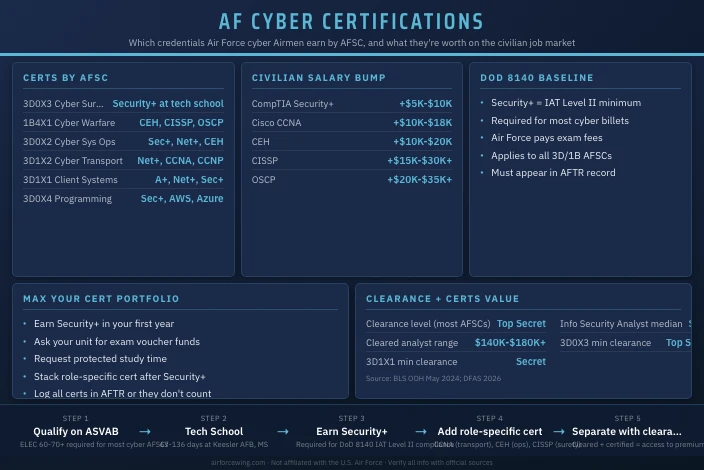
Certifications by AFSC
Different career fields earn different credentials based on their technical focus. Here’s what each cyber and communications AFSC typically earns.
3D0X3 Cyber Surety: Security+ Before You Leave Tech School
Cyber Surety is the only enlisted Air Force AFSC where passing a certification exam is a formal condition for graduating tech school. The three-course training sequence at Keesler AFB, MS ends with a CompTIA Security+ examination. No passing score, no AFSC. That’s a 50-day pipeline that produces Airmen who arrive at their first duty station already meeting the DoD 8140 IAT Level II baseline.
After the first duty station, Cyber Surety Airmen pursue more advanced credentials. Common targets include:
- CISSP (Certified Information Systems Security Professional) for senior IA roles
- CISM (Certified Information Security Manager) for management-track NCOs
- CEH (Certified Ethical Hacker) for Airmen moving into vulnerability assessment
- CAP (Certified Authorization Professional) for authorization and accreditation work
The career field’s mission, reviewing configurations, auditing access controls, certifying systems for classified use, maps directly onto the CISSP body of knowledge. Airmen who earn CISSP before separating consistently report stronger offers from defense contractors than peers without it.
1B4X1 Cyber Warfare Operations: Advanced Credentials for Offensive Operators
The 1B4X1 career field requires ELEC 70 on the ASVAB and a Top Secret/SCI clearance, which already puts it in a different category from most IT AFSCs. Certification targets reflect the offensive and advanced defensive nature of the work.
The Air Force funds credentialing in:
- CompTIA Security+ (IAT Level II baseline, earned early in first assignment)
- CEH (Certified Ethical Hacker) for operators in exploitation and attack roles
- CISSP for senior operators moving into program or team leadership
- OSCP (Offensive Security Certified Professional) at advanced assignments
OSCP carries specific weight in the civilian offensive security market. It’s a hands-on, practical exam where candidates exploit real systems in a timed lab environment. Private sector penetration testing firms pay a premium for cleared professionals who hold it. Operators assigned to Cyber Mission Force teams under U.S. Cyber Command may pursue even more specialized credentials depending on their mission set, though many of those are classified.
3D0X2 Cyber Systems Operations: The Defense and Sysadmin Track
Cyber Systems Operations Airmen build and defend Air Force server infrastructure and networks. The certification path reflects that dual role.
- CompTIA Security+ satisfies the DoD 8140 IAT Level II requirement and is often earned during or shortly after tech school at Keesler AFB
- CompTIA Network+ for Airmen focused on network security and monitoring
- CEH at mid-career, particularly for Airmen in Cyber Security Service Provider (CSSP) billets with SEI 060
- CISSP for senior NCOs moving into cybersecurity management roles
Microsoft and cloud platform credentials (AWS, Azure) are increasingly supported at tech-forward units as the Air Force migrates workloads to cloud environments. An Airman who pairs Security+ with an AWS Solutions Architect Associate or Microsoft Azure Administrator credential before separating has two directions to go: pure cybersecurity or cloud infrastructure.
3D1X2 Cyber Transport Systems: The Networking Certification Path
Cyber Transport Systems is the enterprise networking career field. The ASVAB requirement is one of the highest in the enlisted Air Force, and the TS/SCI clearance requirement matches 3D0X2. The certification targets are networking-specific.
- CompTIA Network+ as the foundational networking credential, typically the first target
- CompTIA Security+ for DoD 8140 compliance, earned alongside Network+
- Cisco CCNA (Cisco Certified Network Associate) as the industry standard for routing and switching
- Cisco CCNP (Cisco Certified Network Professional) at the Staff Sergeant level and above
CCNA and CCNP carry real market value. Cisco credentials signal hands-on routing and switching competence, the kind that took 136 days of technical training at Keesler to build. The Air Force funds the exam fees; the skill base is already there from the job.
3D1X1 Client Systems: CompTIA Credentials for the IT Foundation
Client Systems is the most broadly distributed IT AFSC in the Air Force. Every installation needs desktop support. The certification path is straightforward.
- CompTIA A+ as the hardware and operating system foundation, often the first credential
- CompTIA Network+ for connectivity troubleshooting and networking fundamentals
- CompTIA Security+ for DoD 8140 compliance, nearly standard across all communications roles
- Microsoft 365 and Azure Administrator certifications as the Air Force expands cloud usage
Airmen who earn CompTIA A+ and Security+ in their first term arrive at civilian job interviews with verified credentials. Defense contractors and federal IT shops don’t ask whether you have a degree first. They ask whether you have the clearance and the certs.
3D0X4 Computer Systems Programming: IA Requirement Plus Dev Credentials
Computer Systems Programmers face a different entry gate: both the standard ASVAB (GEND 64) and the Air Force Electronic Data Processing Test (EDPT), scored at 71. The IA credential requirement applies here too.
- CompTIA Security+ satisfies the mandatory DoD 8140 IAT Level II requirement for AFSC award and retention
- AWS, Azure, and Kubernetes credentials supported at tech-forward units
- Project Management Professional (PMP) relevant for senior NCOs managing development projects
Software developers with active Secret clearances and cloud certifications are in short supply. The Air Force creates that combination in a 70-day tech school pipeline.
What These Certifications Are Worth Civilian-Side
Certifications add salary premium on top of whatever baseline the job title commands. The specific combination of credential plus clearance is where the real number sits.
| Certification | Civilian Salary Bump | Who Holds It |
|---|---|---|
| CompTIA Security+ | $5,000-$10,000 above baseline | IAT Level II baseline for cleared roles |
| CompTIA Network+ | $4,000-$8,000 above baseline | Network admin and support roles |
| Cisco CCNA | $10,000-$18,000 above baseline | Network engineer positions |
| Cisco CCNP | $15,000-$25,000 above baseline | Senior network engineer roles |
| CEH | $10,000-$20,000 above baseline | Penetration testing and security analysis |
| CISSP | $15,000-$30,000+ above baseline | Senior IA management and architect roles |
| OSCP | $20,000-$35,000+ above baseline | Offensive security and red team roles |
Salary premium estimates reflect civilian market data for cleared professionals. Cleared candidates consistently earn above published median figures.
The clearance multiplies these numbers. A civilian information security analyst earns a median of $124,910 per year across all employers. Cleared analysts in defense contracting routinely earn $140,000 to $180,000 for equivalent roles, because the government and prime contractors pay to avoid the 6-18 month clearance investigation wait.
An Airman separating with a Top Secret clearance, a CISSP, and four years of hands-on Air Force network defense experience isn’t competing against entry-level candidates. They’re competing for mid-career roles.
How to Maximize Your Cert Portfolio During Service
The Air Force will pay for your exams, but it won’t chase you down to schedule them. The Airmen who leave service with the strongest credential portfolios are the ones who treat certification as a professional obligation, not an optional upgrade.
Practical steps that matter:
- Earn Security+ in your first year. Every cyber and communications AFSC needs it for DoD 8140 compliance. Get it done early rather than scrambling when a new billet requires it.
- Ask your unit about exam voucher programs. Most Education Centers can authorize exam fees. Some units have dedicated professional development funds separate from the standard TA budget.
- Request protected study time. Supervisors who are serious about certification track their Airmen’s progress. If yours doesn’t bring it up, you bring it up.
- Stack credentials strategically. Security+ first, then the cert that matches your specific role. Network operators should pursue CCNA next. Surety Airmen should target CISSP. Programmers should add a cloud cert.
- Log your certs in your official record. Certifications that aren’t in your training records don’t exist for promotion boards. Make sure every credential appears in the Air Force Training Record (AFTR).
The Airman who walks out of a four-year commitment with Security+, a role-specific mid-level credential (CCNA, CEH, or CISSP), and a clearance has effectively purchased a civilian career with four years of service time.
The Clearance Is Part of the Package
No credential discussion for Air Force cyber AFSCs is complete without accounting for the clearance. Every career field covered here requires at minimum a Secret clearance (3D1X1), with most requiring Top Secret or Top Secret/SCI (1B4X1, 3D0X2, 3D1X2, 3D0X3).
The clearance itself has market value independent of any certification. Defense contractors pay cleared professionals a premium specifically to avoid the cost and time of obtaining clearances for civilian hires. A cleared, certified Airman doesn’t just have credentials. They have access to a job market that most civilians can’t enter at all.
That combination, operational experience, verified certifications, and an active government clearance, is what makes these AFSCs worth understanding before you sign an enlistment contract. The Air Force builds the credential portfolio for you. The question is whether you’ll take full advantage of it.
This site is not affiliated with the U.S. Air Force or any government agency. Verify all information with official Air Force sources before making enlistment or career decisions.
For a full picture of what these credentials lead to in the civilian tech job market, the Air Force STEM jobs and civilian tech careers pillar covers civilian outcomes across all STEM AFSCs. The Air Force vs civilian tech salary comparison breaks down the total compensation math, including the clearance premium. You may also find our guide to Air Force cyber careers and the ASVAB study guide useful as you map out your path.