Air Force Civil Engineering vs Army Engineer
Both the Air Force and Army have engineering career fields. Both will train you in construction, heavy equipment, or specialty trades at no cost. But if you’re comparing the two, the daily reality and long-term career picture are different enough that picking the wrong one is a real mistake. The missions are structured differently, the field conditions are different, and the civilian licensing paths point in different directions.
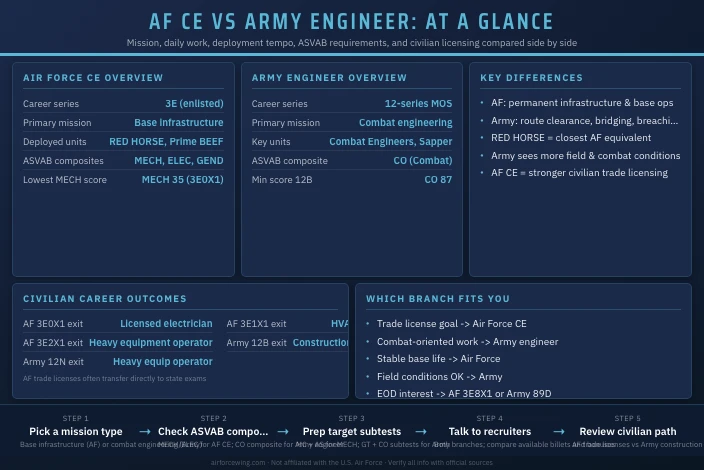
What Air Force CE Does
Air Force civil engineering centers on installation infrastructure. Every base the Air Force operates, in the U.S., in Europe, in the Pacific, and at forward locations, needs electrical systems, water lines, fuel distribution, runways, and buildings. The 3E career group is responsible for all of it.
Seven enlisted AFSCs make up the Air Force CE career field:
| AFSC | Role | Primary Work |
|---|---|---|
| 3E0X1 | Electrical Systems | Wiring, power distribution, generators |
| 3E1X1 | HVAC and Refrigeration | Climate control, refrigeration systems |
| 3E2X1 | Pavements and Construction Equipment | Runways, roads, heavy equipment operation |
| 3E4X1 | Water and Fuels Systems | Potable water, wastewater, aviation fuel |
| 3E5X1 | Engineering | Drafting, surveying, contract oversight |
| 3E7X1 | Fire Protection | Aircraft crash and structural fire response |
| 3E8X1 | Explosive Ordnance Disposal | IED and unexploded ordnance disposal |
Most of this work happens at established installations. A 3E0X1 Airman in Germany or Japan spends the majority of their career maintaining base electrical infrastructure. That’s not a limitation, it means the skills are deep and specific, and they translate directly to licensed civilian trades.
The high-deployment tier of Air Force CE lives in two specialized units. RED HORSE (Rapid Engineer Deployable Heavy Operational Repair Squadron Engineering) deploys to austere and contingency environments to build and repair facilities with organic equipment and minimal external support. Prime BEEF (Base Engineer Emergency Force) teams respond rapidly to base damage from attack, storm, or equipment failure. Both draw from the same 3E AFSCs, eligibility opens after earning a 5-skill level in any CE specialty.
What Army Engineers Do
Army engineer career fields run under the 12-series MOS system. The mission focus is different from the start: Army engineers support ground combat operations. That includes route clearance, obstacle breaching, constructing and destroying bridges, and building survivable fighting positions.
The core 12-series MOS jobs are:
| MOS | Title | Mission |
|---|---|---|
| 12B | Combat Engineer | Breaching, route clearance, demolitions, obstacle emplacement |
| 12C | Bridge Crewmember | Constructing and operating tactical bridging systems |
| 12K | Plumber | Water distribution and plumbing systems |
| 12M | Firefighter | Installation and forward area fire response |
| 12N | Horizontal Construction Engineer | Heavy equipment operation, earthwork, grading |
| 12P | Prime Power Production Specialist | Electrical power generation in deployed environments |
| 12R | Interior Electrician | Electrical systems on Army installations |
| 12T | Technical Engineer | Surveying, drafting, construction project oversight |
| 12W | Carpentry and Masonry | Building construction, concrete, wood framing |
| 12Y | Geospatial Engineer | Terrain analysis and mapping for engineer operations |
Combat engineers (12B) are the most prominent. Their job includes clearing IED-laden routes and breaching fortified obstacles, work that happens in direct contact with the enemy. Sapper is the informal title for soldiers who complete the demanding Sapper Leader Course and carry the tab. It’s one of the most respected credentials in the Army engineer community.
Not all Army engineer jobs are combat-oriented. Horizontal construction (12N), electrical (12R, 12P), and plumbing (12K) roles have missions more similar to Air Force CE than to combat engineering. But even those roles serve an Army that deploys more frequently to austere field conditions than Air Force installations typically see.
Daily Work Compared
This is where the difference is most concrete.
A 3E0X1 Airman maintains electrical systems on an Air Force installation. That means working in electrical rooms, diagnosing distribution faults, replacing panels, and maintaining airfield lighting. The environment is controlled. The equipment is permanent. Projects follow a planned maintenance cycle.
A 12P Army soldier does something structurally similar, power generation in deployed environments, but the context is a forward operating base where grid power doesn’t exist, timelines are compressed, and the base might be under indirect fire. The task is the same in principle; the conditions are not.
3E2X1 vs 12N is probably the most direct comparison on heavy equipment. Both operate bulldozers, graders, and compactors. An Air Force Airman in this role builds and repairs runways at established bases. An Army soldier in 12N builds forward roads and earthworks in field environments, often in less stable terrain and under tighter time pressure.
The standout exception is RED HORSE. A RED HORSE assignment brings Air Force CE closer to Army-style conditions, remote locations, limited logistics, and a construction mission that has to succeed without commercial contractor support. But RED HORSE is a specialized assignment, not the default experience for 3E Airmen. Most Air Force CE work is more stable and more predictable.
Deployment Tempo
Both fields deploy, but the patterns are different.
Air Force deployments typically run on a rotational schedule. Most Air Force CE Airmen deploy for 6-month tours to established bases or contingency locations. RED HORSE units deploy more frequently and to less developed environments, but the cycle is still structured.
Army engineers, especially combat engineer units, deploy with their brigade combat teams. That means multiple 9- to 12-month deployments across a career, often to locations where the threat environment is more active. Route clearance missions in 12B are among the highest-risk assignments in the Army.
The quality-of-life difference is real. Air Force installations generally have more complete support infrastructure: better housing, more stable connectivity, more predictable schedules. Army forward bases vary widely. Some are comfortable, well-established bases. Others are patrol bases with austere conditions for the full deployment length.
ASVAB Requirements
The composites and minimum scores differ between branches.
Air Force 3E career field minimums:
| AFSC | Composite | Minimum Score |
|---|---|---|
| 3E0X1 Electrical Systems | MECH + ELEC | MECH 35, ELEC 35 |
| 3E1X1 HVAC and Refrigeration | MECH or ELEC | MECH 47 or ELEC 28 |
| 3E2X1 Pavements and Construction | MECH | 40 |
| 3E4X1 Water and Fuels Systems | MECH + ELEC | MECH 47, ELEC 28 |
| 3E5X1 Engineering | GEND | 49 |
| 3E7X1 Fire Protection | GEND | 38 |
| 3E8X1 Explosive Ordnance Disposal | MECH + GEND | MECH 60, GEND 64 |
Army 12-series MOS minimums (ASVAB Combat/General Technical):
| MOS | Composite | Minimum Score |
|---|---|---|
| 12B Combat Engineer | CO | 87 |
| 12C Bridge Crewmember | CO | 87 |
| 12N Horizontal Construction | CO | 88 |
| 12P Prime Power | EL + GT | EL 93, GT 107 |
| 12R Interior Electrician | EL | 93 |
| 12T Technical Engineer | GT | 100 |
The Air Force uses its own composite formulas (MECH, ELEC, GEND, ADMI). The Army uses different composites (Combat, General Technical, Electronics). They can’t be directly compared on a single scale, but the Air Force minimum for most CE jobs sits lower than the Army’s equivalent technical roles. Army 12P Prime Power (EL 93, GT 107) is among the most demanding score thresholds in either branch for an engineering-type role.
Civilian Licensing Paths
This is where Air Force CE has a clear structural advantage.
Most Air Force 3E AFSCs train on specific, licensed civilian trades. The military pipeline functions similarly to a registered apprenticeship program. Electricians (3E0X1) train on content that parallels journeyman-level electrical work. HVAC technicians (3E1X1) train toward EPA 608 certification. Firefighters (3E7X1) can pursue IFSAC certification during service. EOD technicians (3E8X1) have a direct pipeline to the FBI Bomb Technician program.
| AF AFSC | Civilian Career | Typical License/Certification |
|---|---|---|
| 3E0X1 | Electrician | State journeyman/master license |
| 3E1X1 | HVAC Technician | EPA 608, state contractor license |
| 3E2X1 | Heavy Equipment Operator | CDL, OSHA certifications |
| 3E4X1 | Utilities Technician | Water operator license, API fuel cert |
| 3E7X1 | Firefighter | IFSAC/ProBoard firefighter cert |
| 3E8X1 | Bomb Technician | FBI Bomb Tech program |
Army engineering experience transfers to civilian work, but less often through formal licensure. A 12B combat engineer builds demolitions and breaching skills that don’t have a direct civilian license. A 12N heavy equipment operator can pursue the same CDL and OSHA credentials as 3E2X1. A 12P prime power specialist has strong electrical skills but may need additional coursework to reach state licensure.
The clearest parallel is 12N vs 3E2X1. Both operate heavy equipment, and both produce experience that civilian construction employers value. The Air Force pipeline tends to be more focused on a specific trade; the Army pipeline tends to be broader and more improvised in field conditions.
Civilian electricians and HVAC technicians consistently rank among the most in-demand tradespeople. The Air Force CE pipeline gets you most of the way to those credentials. That’s harder to replicate from the combat engineer side of the Army.
Physical Demands and Field Conditions
Both career fields require physical fitness. The difference is in the conditions the work happens under.
Air Force CE work is physical but rarely hazardous in a combat sense. Most roles involve outdoor work, lifting, climbing, and operating machinery. EOD is the exception, the psychological demands and physical requirements go beyond the standard for any other 3E AFSC.
Army combat engineers work in more consistently demanding field conditions. Route clearance missions require full gear in heat and dust. Bridge construction involves cold water, current, and heavy rigging. These aren’t hypothetical conditions, they’re standard for deployed units.
RED HORSE narrows the gap from the Air Force side. RED HORSE deployments are physically demanding and austere. But RED HORSE is a volunteer assignment, not something every 3E Airman experiences. Army combat engineers don’t opt into field conditions, those conditions come with the MOS.
Which One Fits
Choose Air Force CE if you want a specific licensed trade, more predictable deployment cycles, and a clearer path to a civilian credential after service. The 3E career field is strong for anyone targeting electrician, HVAC, firefighting, or utilities work as a long-term civilian career.
Choose Army engineering if you want a more operationally intense environment, are drawn to combat support missions, and are comfortable with longer and more frequent deployments to field conditions. The combat engineer path, especially with a Sapper tab, carries significant respect and opens doors to Army special operations pipelines like Ranger Regiment and Special Forces.
Neither is better in the abstract. They fit different people.
This site is not affiliated with the U.S. Air Force, the U.S. Army, or any government agency. ASVAB score requirements, bonus availability, and assignment policies can change. Verify current figures with a recruiter from the branch you’re considering before making any enlistment decisions.
For full profiles on every Air Force CE specialty, see the Air Force civil engineering career group. You may also find Air Force Civil Engineering AFSC Jobs and Air Force ASVAB test prep helpful if you’re deciding which CE role to target.