Air Force Civil Engineering AFSC Jobs
Every runway the Air Force uses, every power grid feeding a hangar, every water line running to a deployed forward operating base, the 3E career group keeps all of it running. Seven enlisted AFSCs make up this career field, and they cover more ground than most applicants realize: electrical work, HVAC, heavy construction, utilities, firefighting, and bomb disposal. If hands-on technical work with real stakes appeals to you, the civil engineering career group is worth a serious look before you sign anything.
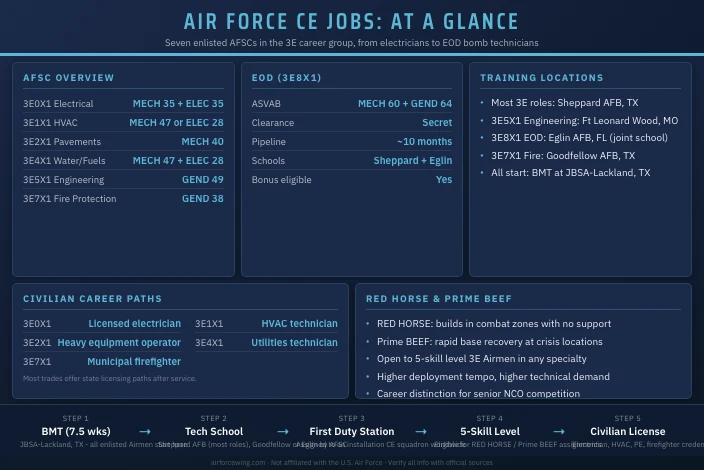
What the 3E Career Group Actually Does
The official name is Civil Engineering, but that label undersells the scope. These Airmen build and maintain the physical infrastructure that Air Force operations depend on. Runways can’t launch fighters if the pavement is cracked. Hangars can’t house aircraft if the climate control fails. A deployed base can’t function if the water supply or fuel lines are compromised.
The 3E group divides into three clusters based on work type.
Electrical and mechanical systems includes 3E0X1 Electrical Systems and 3E1X1 HVAC and Refrigeration. Both deal with the built environment: wiring, distribution panels, generators, cooling equipment, and refrigeration units. The skills map almost directly onto licensed civilian trades. Electricians and HVAC technicians are among the most consistently employed tradespeople in the country, and the military pipeline gets you most of the way to a state license.
Construction and utilities covers 3E2X1 Pavements and Construction Equipment, 3E4X1 Water and Fuels Systems Maintenance, and 3E5X1 Engineering. The scope here ranges from operating a bulldozer on a runway repair job to managing potable water treatment systems to overseeing facility construction contracts. These aren’t support roles in the background, water and fuel failures directly halt flight operations.
High-risk, mission-critical describes 3E7X1 Fire Protection and 3E8X1 Explosive Ordnance Disposal. Aircraft crash response, fuel fire suppression, and bomb disposal are the missions here. Both require specific physical and psychological fitness beyond a test score. EOD has the most demanding qualification process in the entire career field.
The Seven AFSCs: Score Requirements and Training
| AFSC | Title | ASVAB Composite | Min Score | Tech School | Clearance |
|---|---|---|---|---|---|
| 3E0X1 | Electrical Systems | MECH + ELEC | MECH 35, ELEC 35 | 99 days, Sheppard AFB, TX | None |
| 3E1X1 | HVAC and Refrigeration | MECH or ELEC | MECH 47 or ELEC 28 | 98 days, Sheppard AFB, TX | None |
| 3E2X1 | Pavements and Construction | MECH | MECH 40 | Sheppard AFB, TX | None |
| 3E4X1 | Water and Fuels Systems | MECH + ELEC | MECH 47, ELEC 28 | ~18 weeks, Sheppard AFB, TX | None |
| 3E5X1 | Engineering | GEND | GEND 49 | 71 days, Fort Leonard Wood, MO | None |
| 3E7X1 | Fire Protection | GEND | GEND 38 | ~14 weeks, Goodfellow AFB, TX | None |
| 3E8X1 | Explosive Ordnance Disposal | MECH + GEND | MECH 60, GEND 64 | ~10 months, Sheppard + Eglin AFB, FL | Secret |
Scores reflect published qualifying thresholds and may change. Verify current minimums with your recruiter before MEPS.
The training pipeline for every enlisted Airman starts with Basic Military Training at Joint Base San Antonio-Lackland, TX, 7.5 weeks before Tech School begins. After that, the 3E group splits across three training locations depending on specialty.
Most of the career field trains at Sheppard AFB, TX: 3E0X1, 3E1X1, 3E2X1, and 3E4X1 all go there. The 3E5X1 Engineering specialty stands alone, it trains at Fort Leonard Wood, MO, the only 3E role that goes to a different installation. Fire Protection (3E7X1) trains at Goodfellow AFB, TX. EOD (3E8X1) is the longest pipeline: the first phase runs at Sheppard, then continues at the Naval School Explosive Ordnance Disposal (NAVSCOLEOD) at Eglin AFB, FL, a joint school where Air Force students train with Army, Navy, and Marine EOD candidates.
3E0X1 Electrical Systems
3E0X1 Airmen install, maintain, and repair electrical systems on Air Force installations. That means power distribution panels, wiring, generators, exterior lighting, and airfield lighting systems. The dual composite requirement, MECH 35 and ELEC 35: means you have to clear both thresholds. Scoring well on one and missing the other still disqualifies you.
Tech School runs 99 days at Sheppard. The curriculum mirrors apprentice-level electrical training, and the skills build directly toward civilian journeyman and master electrician licensing. States vary in how they credit military experience, but most count the training hours and work experience toward exam eligibility.
Civilian licensed electricians consistently appear on shortage lists across most major metro areas. This is among the most in-demand skilled trades in the country, and the Air Force pipeline gets you in the door.
3E1X1 HVAC and Refrigeration
The HVAC specialty maintains climate control and refrigeration systems across Air Force facilities. The composite requirement uses an or structure rather than requiring both: you qualify with MECH 47 or ELEC 28. That ELEC 28 threshold is notably low, making 3E1X1 one of the more accessible mechanical roles for applicants whose electronics subtest scores are weaker.
Tech School is 98 days at Sheppard. The training covers refrigeration cycles, airside systems, and mechanical troubleshooting, content that aligns with the EPA 608 certification and state HVAC contractor licensing paths used in the civilian sector.
3E2X1 Pavements and Construction Equipment
Pavements Airmen operate and maintain heavy construction equipment: bulldozers, asphalt pavers, compactors, motor graders, and scrapers. The primary mission is building and repairing runways, taxiways, roads, and other paved surfaces. Under deployed conditions, this often means repairing battle-damaged runways fast enough to restore flight operations.
The MECH 40 requirement is one of the lower thresholds in the career group, but don’t confuse accessibility with low demand. Operating heavy equipment on an active airfield under time pressure is skilled, physically demanding work. RED HORSE assignments draw heavily from this specialty.
3E4X1 Water and Fuels Systems Maintenance
Water and Fuels Airmen manage potable water treatment, wastewater processing, and aviation fuel distribution. When a water treatment system fails at an operating base, the base stops functioning. When a fuel distribution system goes down, aircraft don’t fly. The job is as critical as its description is quiet.
The dual composite requirement, MECH 47 and ELEC 28: means both thresholds must be met. Tech School runs roughly 18 weeks at Sheppard, covering hydraulics, pump systems, water chemistry, and fuel quality control procedures.
3E5X1 Engineering
3E5X1 is the most office-oriented role in the career group. Engineering Airmen handle drafting and design support, land surveying, construction contract oversight, and facility project management. The ASVAB requirement is GEND 49: a general composite drawing from Word Knowledge, Paragraph Comprehension, Arithmetic Reasoning, and Mathematics Knowledge, rather than a mechanical composite. That makes it the right fit for applicants whose verbal and math reasoning scores are strong but whose mechanical subtests are weaker.
Training runs 71 days at Fort Leonard Wood, MO. Post-service, 3E5X1 Airmen are well positioned for construction management roles, engineering technician positions, and civil engineering licensure paths, particularly for anyone who continues education after separation.
3E7X1 Fire Protection
Air Force firefighters respond to aircraft crashes, fuel fires, structural fires, and hazardous material incidents. The mission is more varied than most civilian fire assignments, aircraft crash rescue requires specialized techniques and equipment that aren’t standard in municipal departments. A side benefit: 3E7X1 Airmen often cross-train with local civilian fire departments and can pursue civilian fire certification during their service contract.
The ASVAB requirement is GEND 38, the lowest threshold in the 3E group. The ASVAB score is the easy part. Color vision requirements, physical fitness standards, and temperament screening filter applicants beyond the test. Tech School is roughly 14 weeks at Goodfellow AFB, TX.
Civilian transition is straightforward. The International Fire Service Accreditation Congress (IFSAC) recognizes military fire training for certification purposes, and most states accept military fire experience toward testing eligibility.
3E8X1 Explosive Ordnance Disposal
EOD is the hardest qualification in the 3E career group. The dual ASVAB requirement, MECH 60 and GEND 64: demands strong performance on both mechanical and verbal reasoning subtests simultaneously. Very few AFSCs require a dual composite at those levels.
The training pipeline runs close to ten months. The first phase is at Sheppard AFB. The second phase is at NAVSCOLEOD at Eglin AFB, FL, where Air Force students train alongside EOD technicians from all branches. The curriculum covers conventional explosives, improvised explosive devices, and chemical and nuclear ordnance. A Secret clearance is required before the pipeline begins, it’s the only 3E AFSC with a clearance requirement.
The medical screening for EOD is stricter than for any other role in the career group. Physical demands are high, and the psychological requirements account for the stress of working with live ordnance in high-pressure environments.
EOD typically qualifies for enlistment and reenlistment bonuses based on Air Force manning needs. Confirm current bonus availability with your recruiter.
Civilian transition most often goes toward federal law enforcement, bomb technician positions with state and local agencies, and private sector explosive safety roles. The training credential is recognized by the FBI Bomb Technician program, which uses some of the same NAVSCOLEOD coursework as its certification basis.
For a deeper look at EOD entry standards, training pipeline details, and career progression, Air Force EOD: Requirements and Career Path covers the full picture.
RED HORSE and Prime BEEF Units
The standard civil engineering mission is maintaining installations in peacetime. Two units extend that mission into contingency and combat environments.
RED HORSE (Rapid Engineer Deployable Heavy Operational Repair Squadron Engineering) is the Air Force’s construction force for austere and hostile environments. RED HORSE Airmen deploy to locations where commercial contractors can’t operate, building and repairing facilities, runways, and infrastructure with their own organic equipment and minimal external support. Assignments are available to Airmen who have earned their 5-skill level in any 3E AFSC. The work is demanding, the deployments are frequent, and RED HORSE assignments carry significant weight in senior NCO and special duty selection boards.
Prime BEEF (Base Engineer Emergency Force) teams are the rapid response element within the standard civil engineering structure. When a base suffers damage, from attack, storm, or equipment failure. Prime BEEF teams restore critical facilities and systems on a compressed timeline. Every 3E Airman participates in Prime BEEF training as part of standard unit readiness.
ASVAB Composites for CE Jobs
Five of the seven 3E AFSCs require the MECH composite (General Science + Auto/Shop + Mathematics Knowledge + Mechanical Comprehension). That makes Mechanical Comprehension and Auto/Shop the two highest-priority subtests for anyone targeting this career field.
Two roles, 3E5X1 and 3E7X1, require only the GEND composite (Word Knowledge + Paragraph Comprehension + Arithmetic Reasoning + Mathematics Knowledge). EOD requires both MECH and GEND at elevated thresholds.
| Composite | Subtests | 3E Jobs Using It |
|---|---|---|
| MECH | GS + AS + MK + MC | 3E0X1, 3E1X1, 3E2X1, 3E4X1, 3E8X1 |
| ELEC | GS + AR + MK + EI | 3E0X1, 3E1X1, 3E4X1, 3E8X1 |
| GEND | WK + PC + AR + MK | 3E5X1, 3E7X1, 3E8X1 |
For applicants who haven’t yet taken the ASVAB, this table is a study roadmap. Mechanical Comprehension and Auto/Shop will do the most work across the broadest range of CE jobs. If EOD is your target, don’t skip the verbal subtests, the GEND 64 minimum means Word Knowledge and Paragraph Comprehension matter as much as the mechanical sections.
The AFQT minimum for Air Force enlistment is 36. That score opens the door to the recruiter conversation; the composite scores above determine which 3E jobs you can actually access. A full breakdown of CE line score requirements and study priorities is in best ASVAB scores for civil engineering AFSC jobs.
Pay and Allowances
Civil engineering AFSCs receive the same base pay as all other Air Force enlisted career fields. Pay increases with rank and years of service.
| Grade | Rank | Monthly Base Pay (2026) |
|---|---|---|
| E-1 | Airman Basic | $2,407 |
| E-2 | Airman | $2,698 |
| E-3 | Airman First Class | $2,837 - $3,198 |
| E-4 | Senior Airman | $3,142 - $3,816 |
| E-5 | Staff Sergeant | $3,343 - $4,422 |
| E-6 | Technical Sergeant | $3,401 - $5,044 |
| E-7 | Master Sergeant | $3,932 - $5,537 |
Base pay doesn’t include allowances. Most Airmen living off-base receive Basic Allowance for Housing (BAH), which varies by duty station and dependent status. The flat Basic Allowance for Subsistence (BAS) adds $476.95 per month for all enlisted members. TRICARE Prime active-duty coverage carries no enrollment fee, deductible, or copay.
EOD and some other high-demand 3E specialties carry enlistment bonuses depending on Air Force manning priorities. Bonus eligibility changes on a fiscal year cycle, confirm current amounts with your recruiter.
Civilian Career Paths After Service
One of the most compelling features of the 3E career group is the direct line from military training to licensed civilian trades. Most of these roles don’t require additional schooling after separation, the military pipeline qualifies you for state licensing exams or certification processes directly.
| AFSC | Civilian Career | Licensing/Credential Path |
|---|---|---|
| 3E0X1 | Electrician | Journeyman/master electrician licensure (state) |
| 3E1X1 | HVAC Technician | EPA 608, state HVAC contractor license |
| 3E2X1 | Heavy Equipment Operator | CDL, OSHA certifications, union trades |
| 3E4X1 | Utilities Technician | Water treatment operator license, API fuel certifications |
| 3E5X1 | Engineering Technician | EIT exam pathway, PE licensure with education |
| 3E7X1 | Firefighter | IFSAC/ProBoard certifications, municipal fire positions |
| 3E8X1 | Bomb Technician | FBI Bomb Tech program, federal/state LE positions |
The trade licensing paths from 3E0X1 and 3E1X1 are among the most direct in the enlisted force. Civilian electricians and HVAC technicians earn $55,000-$100,000+ depending on location and experience level, with licensed contractors running their own operations making considerably more. For the full analysis of which CE jobs produce the best civilian outcomes, Air Force CE jobs that lead to civilian construction careers compares post-service salaries and licensing timelines across the career group.
If civilian engineering licensure is the goal, best Air Force engineering AFSC for civilian licensing lays out which roles offer the clearest path to a Professional Engineer credential.
Air Force CE vs. Army Engineer
Both the Air Force and Army have engineering career fields, but the mission focus and day-to-day work differ significantly. Air Force CE centers on maintaining and building installation infrastructure, the work stays close to established bases and operating locations. Army engineer missions include combat engineering: breaching obstacles, building temporary bridges, and clearing routes under fire.
The tradeoff is between stability and intensity. Air Force CE Airmen generally have more predictable deployments and work environments. Army engineer Airmen operate in more kinetic settings. RED HORSE narrows the gap at the high-deployment end, but even RED HORSE operates differently from combat engineers clearing IED-laden roads. The full comparison is in Air Force civil engineering vs: Army engineer.
Which CE AFSC Is Right for You
A few questions will narrow the list quickly.
Do you want a licensed trade? 3E0X1 and 3E1X1 have the clearest paths to electrician and HVAC licensure. Both are trades with high civilian demand and strong wage growth.
Do you want to work outdoors on large projects? 3E2X1 and 3E4X1 are the most physically active roles in the group. You’ll operate heavy equipment or manage field systems rather than work in mechanical rooms.
Are your verbal and math scores stronger than your mechanical scores? 3E5X1 Engineering and 3E7X1 Fire Protection both use the GEND composite rather than MECH. If your Auto/Shop and Mechanical Comprehension subtests are weak, these are the two CE roles still accessible to you.
Do you want the highest-stakes role in the career field? 3E8X1 EOD is the most demanding entry qualification, the longest training pipeline, and the highest operational intensity in the 3E group. It also carries the clearest federal civilian career path after service.
Whatever role fits, all of them share one quality: the work is visible. When a runway is repaired, when a fire is contained, when a bomb is disarmed, there’s no ambiguity about whether the job got done.
This site is not affiliated with the U.S. Air Force or any government agency. ASVAB line score requirements and bonus availability can change when AFI 36-2101 is updated or at the start of a new fiscal year. Verify current requirements with an Air Force recruiter before making any enlistment decisions.
Review all seven AFSC profiles and current training details at the Air Force civil engineering career group. For test prep, the Air Force ASVAB study guide covers the MECH and ELEC composites that unlock most 3E jobs.