Air Force CE Jobs That Lead to Civilian Construction Careers
Construction trades are short on workers. Electricians, HVAC technicians, plumbers, heavy equipment operators, and firefighters are all on workforce shortage lists in most major metro areas. The Air Force 3E career group trains people in exactly those skills, and the military pipeline covers years of hands-on experience that civilian employers and licensing boards give full credit for. If you’re considering an enlistment and want a trade career waiting on the other side, five CE AFSCs map almost directly onto in-demand civilian jobs.
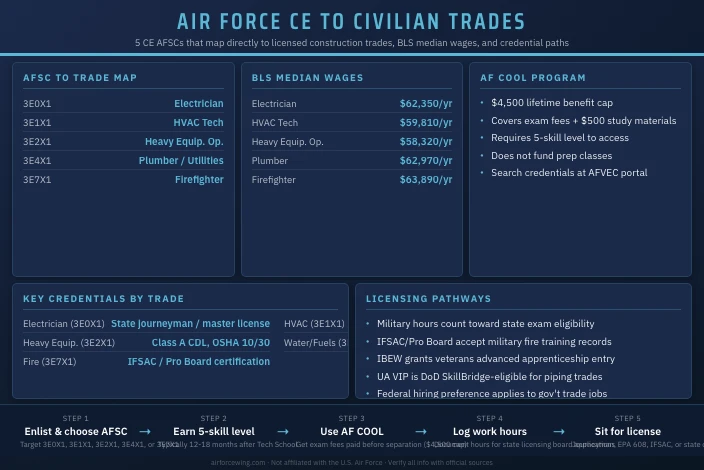
The Trade-to-AFSC Map
The five AFSCs with the clearest civilian construction paths are 3E0X1 (electrician), 3E1X1 (HVAC technician), 3E2X1 (heavy equipment operator), 3E4X1 (plumber and utilities), and 3E7X1 (firefighter). Each one leads to a specific civilian trade with its own licensing body, union apprenticeship structure, and salary range.
| AFSC | Air Force Title | Civilian Trade | BLS Median Wage |
|---|---|---|---|
| 3E0X1 | Electrical Systems | Electrician | $62,350/yr |
| 3E1X1 | HVAC and Refrigeration | HVAC Technician | $59,810/yr |
| 3E2X1 | Pavements and Construction Equipment | Heavy Equipment Operator | $58,320/yr |
| 3E4X1 | Water and Fuels Systems Maintenance | Plumber / Utilities Tech | $62,970/yr |
| 3E7X1 | Fire Protection | Firefighter | $63,890/yr |
These are national medians from the Bureau of Labor Statistics’ May 2024 data. High-cost metro areas, union scale, and contractor status push wages considerably higher. A licensed master electrician running their own shop in a major city earns well over $100,000.
3E0X1 Electricians: The Most Direct Path to Licensure
3E0X1 Airmen install and maintain power distribution systems, wiring, generators, and airfield lighting. The 99-day Tech School at Sheppard AFB covers content that mirrors the first year or two of a civilian apprenticeship program. Most states require applicants to log between 8,000 and 10,000 hours of supervised work experience before sitting for a journeyman exam. Military service counts toward those hours in nearly every state.
After journeyman licensure, the next step is master electrician certification, which opens the door to running jobs independently and pulling permits. The earnings gap between a journeyman and a licensed master electrician is substantial.
The International Brotherhood of Electrical Workers (IBEW) recognizes military electrical training for apprenticeship credit. Veterans with 3E0X1 experience often enter civilian apprenticeship programs at an advanced level rather than starting from scratch. Some IBEW locals waive the standard entry requirements entirely for veterans with qualifying military experience.
AF COOL covers exam fees and up to $500 in study materials for approved credentials while you’re still on active duty. For 3E0X1, that includes National Institute for Certification in Engineering Technologies (NICET) credentials and other approved technical certifications, a way to build your credential stack before you ever separate.
3E1X1 HVAC: EPA 608 and State Contractor Licensing
3E1X1 Airmen maintain climate control and refrigeration systems. The civilian side of this work requires an EPA Section 608 certification to legally handle refrigerants. That’s a federal requirement, not a state one, and AF COOL covers the exam fee. Most 3E1X1 Airmen can sit for the 608 exam during their service contract rather than waiting until separation.
State-level HVAC contractor licensing requirements vary, but they uniformly accept military training hours toward exam eligibility. The 98-day Tech School curriculum covers refrigeration cycles, airside systems, and mechanical troubleshooting. It maps closely to the content tested on civilian licensing exams.
Civilian HVAC work breaks into two income tiers: service technicians working for employers, and licensed contractors who run their own businesses. The BLS median for HVAC technicians is $59,810, but that figure reflects the service tier. Licensed contractors in commercial HVAC regularly earn six figures.
The UA Veterans in Piping program, a Department of Defense SkillBridge-recognized initiative, offers transitioning Airmen free hands-on HVACR training at select military bases before separation. It’s worth checking whether your installation participates before you start terminal leave.
3E2X1 Heavy Equipment: Unions and CDL Credentials
3E2X1 Airmen operate bulldozers, asphalt pavers, motor graders, and compactors. The civilian equivalent is an Operating Engineer or heavy equipment operator, and it’s one of the most union-dense trades in construction.
Helmets to Hardhats connects transitioning veterans with apprenticeship openings in the building trades, including Operating Engineers through the International Union of Operating Engineers (IUOE). Veterans with 3E2X1 experience typically enter IUOE apprenticeship programs with advanced standing based on their military equipment hours.
A Commercial Driver’s License (Class A CDL) makes 3E2X1 veterans more marketable for both construction site and transport roles. Many 3E2X1 Airmen already hold a military vehicle operator qualification that can simplify the CDL licensing process. OSHA 10 and OSHA 30 construction safety cards are low-cost additions that many contractors require.
The BLS median for construction equipment operators sits at $58,320. Union scale in metro construction markets is higher, and project-based work on infrastructure contracts frequently pays well above scale.
3E4X1 Water and Fuels: Plumbing Licensure and Utilities Trades
3E4X1 Airmen manage potable water treatment, wastewater systems, and aviation fuel distribution. The civilian translation isn’t a single trade. It branches depending on which system you worked most.
Water treatment experience maps to water treatment operator certification, which is issued at the state level and required to run public water systems. Many states have license reciprocity agreements that specifically recognize military water treatment experience. Veterans with 3E4X1 backgrounds can often sit for state operator exams directly rather than completing a civilian training program first.
Fuels-side experience connects to the API (American Petroleum Institute) certification framework, relevant for petroleum storage and distribution work. The plumbing side of the 3E4X1 skill set maps to plumber licensure, which follows the same journeyman-to-master progression as electricians. BLS puts the median wage for plumbers, pipefitters, and steamfitters at $62,970, the second-highest among the five CE trades tracked here.
The United Association Veterans in Piping (UA VIP) program is specifically designed for active-duty members and covers piping, HVACR, and fire suppression trades. It’s DoD SkillBridge-eligible, meaning you may be able to complete it on government time during your transition window.
3E7X1 Fire Protection: The Fastest Civilian Transition
3E7X1 has one of the clearest separation-to-employment pipelines in the Air Force. Military fire training is recognized by two major national accreditation bodies: the International Fire Service Accreditation Congress (IFSAC) and Pro Board. Both issue certifications based on military fire training records without requiring you to repeat basic fire courses.
Many states accept IFSAC or Pro Board certification as the basis for state firefighter licensure. Some municipalities hire Air Force veterans directly into career firefighter positions, crediting military service toward the initial probationary period.
The BLS median wage for firefighters is $63,890. That figure reflects municipal fire departments, which typically offer defined-benefit pension plans on top of salary. The total compensation package often looks closer to a military career in terms of long-term security. Many 3E7X1 veterans also qualify for paramedic or EMT crossover programs, which expand their options and often increase starting pay.
The Air Force COOL Program
The AF COOL (Credentialing Opportunities On Line) program pays for professional certifications while you’re still serving. The lifetime benefit cap is $4,500 per member. COOL covers exam fees, up to $500 in study materials, and application costs for approved credentials. It does not fund preparatory classes.
To access COOL, you need your 5-skill level in your AFSC and supervisor approval. The approved credential list is searchable by AFSC or civilian career area at afvec.us.af.mil.
For CE Airmen, COOL is most useful mid-career, after you’ve completed your initial enlistment and earned your 5-level. Using it before you separate means you can walk out with certifications already in hand rather than paying out-of-pocket for exams after you leave.
This site is not affiliated with the U.S. Air Force or any government agency. Credential requirements, COOL funding caps, and program availability can change. Verify current details with your unit education office and official Air Force sources before making separation or career decisions.
Licensing Credit: What States Actually Accept
State licensing boards control how military experience converts to civilian licensure. The rules vary, but the pattern is consistent: states give credit for military training hours and work experience. They just don’t all do it the same way.
A few common structures:
- Hour-for-hour credit: The state accepts military work experience hours toward the minimum required before sitting for an exam.
- Accelerated entry: Some licensing boards let veterans sit for the journeyman exam without completing a civilian apprenticeship first, based on military training records.
- Reciprocity agreements: Some states honor credentials issued by other states or national bodies (like IFSAC for fire) without requiring additional testing.
The best starting point is the licensing board in the state where you plan to work. Bring your training records, Enlisted Performance Reports showing your duty experience, and any certificates from Tech School. Most boards have a specific military-to-civilian pathway on their website.
Salary Reality Check
The BLS medians above are national midpoints. Your actual earnings after separation depend on location, licensing level, whether you join a union, and whether you eventually go independent as a contractor.
The clearest path to higher earnings across all five trades is the same: get licensed, accumulate years of experience, and eventually run your own operation. Military veterans who complete their enlistment, earn journeyman licensure, and work five to ten years in their trade are well-positioned to move into supervisory or contractor roles.
One factor that’s easy to overlook: the federal hiring preference for veterans applies to civilian government positions in public works, utilities, and emergency services. Federal construction and facility management jobs at military installations, national parks, and federal agencies all fall under this preference. A 3E4X1 veteran applying for a federal water treatment position competes in a different category than civilian applicants.
Explore the full Air Force civil engineering career group for individual AFSC profiles and entry requirements. The Air Force benefits guide covers the GI Bill, TRICARE, and other programs that support your transition from military service to civilian trades.
You may also find Air Force civil engineering AFSC jobs and best Air Force engineering AFSC for civilian licensing helpful for understanding the full CE career field and which roles offer the clearest path to professional credentials.