Air Force Bonus for High ASVAB Scores
The ASVAB doesn’t hand you a bonus. But it controls which jobs you can access, and the jobs with the biggest bonuses almost always sit behind the highest score requirements. That’s the connection worth understanding before you test.
When you purchase through links on our site, we may receive compensation at no extra cost to you.
A stronger ASVAB score opens doors to the bonus-eligible jobs that recruiters can’t easily fill. An ASVAB prep course gives you full-length practice tests and section-by-section breakdowns so you know exactly where to improve before test day.
How the ASVAB Controls Your Job Options
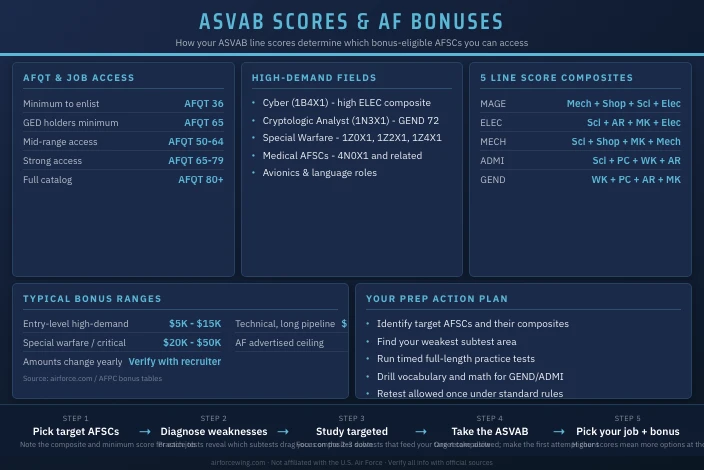
Every Air Force Specialty Code (AFSC) has a minimum composite line score attached to it. If you don’t meet the minimum, a recruiter cannot place you in that job regardless of interest or background. The Air Force uses five composite scores built from groups of ASVAB subtests:
| Composite | Subtests |
|---|---|
| MAGE | Mechanical Comprehension, Auto & Shop, General Science, Electronics |
| ELEC | General Science, Arithmetic Reasoning, Mathematics Knowledge, Electronics |
| MECH | General Science, Auto & Shop, Mathematics Knowledge, Mechanical Comprehension |
| ADMI | General Science, Paragraph Comprehension, Word Knowledge, Arithmetic Reasoning |
| GEND | Word Knowledge, Paragraph Comprehension, Arithmetic Reasoning, Mathematics Knowledge |
Your AFQT score is separate from these composites. It’s a percentile score that determines whether you can enlist at all. The Air Force requires a minimum AFQT of 36 for high school diploma holders and 65 for GED holders. Cross that threshold and the door opens. Your composite scores then determine which jobs you can actually pick.
Someone who scores a 36 on the AFQT clears the minimum bar and nothing more. They’ll qualify for a narrow band of jobs, most of them in lower-demand fields with smaller or no bonuses. Someone who scores a 75 opens up the full catalog, including the technical and specialized AFSCs that consistently attract the largest incentive payments.
The math is straightforward: a higher ASVAB score gives you more jobs. More jobs means more chances to land a bonus-eligible one.
Why Bonus-Eligible Jobs Require High Scores
The Air Force doesn’t pay bonuses randomly. Air Force Personnel Center (AFPC) places bonuses on jobs that are difficult to fill because they require long or expensive training, face heavy competition from civilian employers, or have historically high attrition in their pipelines. Those same characteristics are exactly why those jobs carry strict ASVAB minimums.
Take 1B4X1 Cyberspace Operations. It consistently appears on bonus lists, and it requires a high ELEC composite. The training pipeline runs months long, and the civilian cybersecurity market pays well. The Air Force uses the ASVAB to screen for candidates who can succeed in a technically demanding program, and then adds a financial incentive to compete against private sector offers.
1N3X1 Cryptologic Language Analyst is another example. It sits behind a GEND 72 requirement, plus a separate Defense Language Aptitude Battery. The training involves learning a foreign language to professional proficiency, which can take over a year. Bonuses in this field can be substantial because the investment is enormous and the talent is rare.
Special warfare AFSCs like 1Z0X1 Combat Controller and 1Z2X1 Pararescue carry bonuses because attrition in their selection pipelines is high. The ASVAB minimums exist to ensure candidates have the cognitive foundation to handle technical instruction while enduring physically demanding training.
The pattern holds across medical, avionics, and intelligence fields. High ASVAB requirement and high bonus potential are not a coincidence. They point at the same underlying fact: these jobs are hard to fill with qualified people.
AFQT Thresholds and What They Unlock
The AFQT has a direct effect on which portion of the job catalog you can access. Here’s a practical breakdown of what different score bands mean in terms of job access:
| AFQT Range | What It Opens |
|---|---|
| 36-49 | Meets minimum enlistment. Limited AFSC options. Fewer bonus-eligible jobs. |
| 50-64 | Mid-range access. More technical fields open up. Moderate bonus potential. |
| 65-79 | Strong access to most AFSCs. Many high-demand fields qualify. |
| 80+ | Full catalog access. Qualifies for virtually all enlisted AFSCs including the most competitive bonus-eligible ones. |
These ranges are general. Your composite line scores matter just as much as your AFQT because different AFSCs test different composites. You could have a strong AFQT but a weak ELEC composite and still be locked out of cyber jobs. The reverse is also possible: good composite scores can make specific high-value jobs accessible even at a mid-range AFQT.
The practical implication is that targeted studying pays off. If cyber or intelligence is where you want to land, focus on General Science, Arithmetic Reasoning, Mathematics Knowledge, and Electronics before test day.
The Study ROI Calculation
Think about what an extra 15 points on the AFQT is actually worth.
A recruit who walks in with a 50 qualifies for a reasonable set of jobs but is likely shut out of several fields that carry $15,000 to $30,000 bonuses. A recruit who walks in with a 65 or 70, having put real time into preparation, may qualify for those same fields and have a genuine shot at a job with a substantial incentive.
A prep course costs a fraction of even a $5,000 bonus. A study guide costs less than a tank of gas. The return on test preparation, measured purely against bonus eligibility, is one of the clearest financial calculations a prospective recruit can make.
That’s before accounting for the other downstream benefits of higher scores. Better composite scores mean:
- More job choices at the recruiter’s table
- Access to AFSCs with longer, higher-quality tech school training
- Better civilian market value after your enlistment ends
- Stronger position if you ever want to cross-train into a different AFSC
Studying harder for the ASVAB is not just about the bonus. But for BOFU readers who are specifically weighing whether the effort is worth it, the bonus math alone makes the case.
Which Fields Consistently Offer Bonuses
The Air Force does not publish a public list of current bonus amounts by AFSC. Amounts and availability change based on yearly manning levels. What’s listed below reflects career fields that have historically appeared on bonus programs due to persistent high demand:
Cyber and intelligence
- Cyberspace Operations (1B4X1): requires strong ELEC composite
- Cryptologic Language Analyst (1N3X1): requires GEND 72 plus DLAB
- Intelligence analyst roles: typically require GEND scores in the 50-60 range
Special warfare
- Combat Controller (1Z0X1), Pararescue (1Z2X1), Special Reconnaissance (1Z4X1)
- These jobs require strong overall AFQT and physical qualification; ASVAB floor is one of several gates
Medical
- Aerospace Medical Technician (4N0X1) and related healthcare AFSCs
- Competes against civilian healthcare hiring; bonuses vary by AFSC and current manning
Avionics and maintenance
- Aircraft systems and avionics fields cycle in and out of bonus programs based on fleet needs
- Often require strong MAGE or ELEC composites
Linguists
- Language-qualified AFSCs remain hard to staff; bonus programs for certain languages have historically been strong
None of these are guarantees. Verify current bonus availability for any specific AFSC with a recruiter. The only authoritative list is the one AFPC publishes to recruiters, and it changes with each fiscal year.
How to Act on This Before You Test
The best time to think about bonus eligibility is before you sit down at the ASVAB, not after. Once you have a score in hand, your options are set until you can retest, which the Air Force limits to one retest under standard rules.
Steps worth taking now:
- Identify your target AFSCs. Look at the jobs you’d actually want and note their composite requirements. ASVAB scores for every Air Force AFSC has the full line score chart.
- Find your weakest composite area. If you’re targeting a cyber job, test your Electronics and Arithmetic Reasoning skills. If you’re targeting intelligence, focus on Paragraph Comprehension, Word Knowledge, and Math.
- Run full-length practice tests. Timed practice under test conditions is more valuable than passive review. It shows you exactly which subtests are pulling your composites down.
- Check for flash cards. ASVAB flash cards are effective for drilling vocabulary and math formulas that appear repeatedly across the GEND and ADMI composites.
The full mechanics of enlistment bonuses, payment schedules, and repayment rules are covered in Air Force enlistment bonuses.
You may also find AFSC jobs with the biggest signing bonuses helpful, and Air Force ASVAB test prep covers the preparation strategies that move your score. Browse Air Force enlisted careers to see which career groups offer the highest-demand AFSCs and their composite requirements.
This site is not affiliated with the U.S. Air Force or any government agency. Verify all information with official Air Force sources before making enlistment or career decisions.