Air Force BMT Physical Training: What to Expect
Most people who struggle at Air Force Basic Military Training don’t fail because of the classroom work. They fail because they weren’t ready to run. Physical training starts on Day 1 at Joint Base San Antonio-Lackland, and it doesn’t stop for the full 7.5 weeks. Knowing what to expect lets you show up prepared instead of spending the first two weeks just surviving.
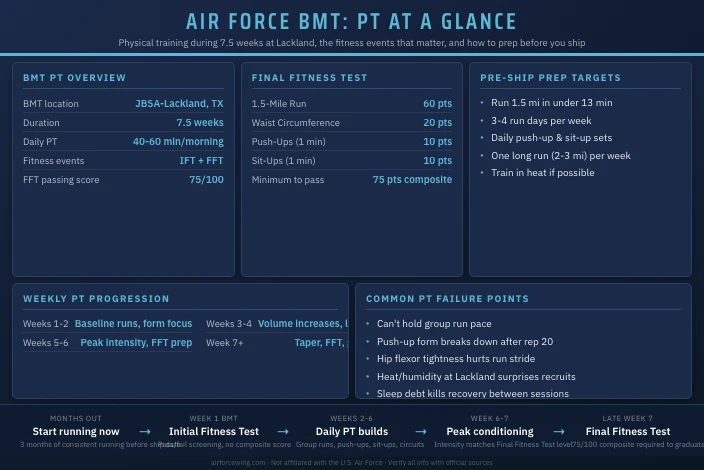
What Physical Training Looks Like at BMT
PT at Lackland happens every morning. Reveille comes early, and your flight is outside within the hour. Sessions run 40 to 60 minutes and combine running, strength work, and body-weight circuits.
Running is the core. The first week focuses on building a base through shorter distances. By week four, flights are running two to four miles at a time. Pace is dictated by the Training Instructor (TI), so you run as a group, not at your own speed. Slower recruits must keep up.
Strength sessions appear two to three times per week. These are not weightroom sessions. Expect:
- Push-up sets and variations (wide, narrow, standard)
- Sit-up sets timed at one minute
- Planks and core work
- Lunges, squats, and other body-weight movements
- Grass drills (burpee-style movements on command)
The conditioning is progressive. Week one is manageable. By week six, the volume and intensity have increased considerably. Recruits who arrive deconditioned spend those early weeks in a constant energy deficit and rarely fully recover before graduation.
The Official Fitness Events at BMT
There are two formal fitness events during BMT: the Initial Fitness Test (IFT) and the Final Fitness Test (FFT).
The IFT happens in the first week. It is a pass/fail screening, not a full scored assessment. Recruits who fail the IFT may be held back or moved to a remedial fitness program before continuing with BMT.
The FFT happens near the end of training. This is the graded test that determines whether you graduate. It mirrors the standard Air Force Fitness Assessment format:
| Event | Max Points | Duration |
|---|---|---|
| 1.5-Mile Run | 60 | Timed run |
| Waist Circumference | 20 | Single measurement |
| Push-Ups | 10 | 1 minute |
| Sit-Ups | 10 | 1 minute |
Total possible score is 100 points. The minimum composite passing score is 75. You must also meet the minimum standard on each component individually. Scoring is age- and gender-normed, so tables differ by those categories.
The run carries most of the weight. Sixty points means your run time alone can determine whether you pass or fail.
How Physical Fitness Progresses Week by Week
BMT is structured, and so is the PT program. The intensity builds on a deliberate schedule.
Weeks 1-2: Orientation and baseline. Running distances are short (one to two miles). The focus is on form, group cohesion, and identifying recruits who need extra attention. This period feels manageable, but do not mistake it for easy.
Weeks 3-4: The volume increases. Runs get longer and faster. Strength sessions become more demanding. This is when recruits who arrived underfit begin to fall behind.
Weeks 5-6: Peak conditioning period. Sessions now resemble the intensity you’ll face at the FFT. Long runs, timed events, and combined circuits. Recruits who have been consistent start feeling strong. Those who have been struggling hit a wall.
Week 7 and graduation phase: Volume tapers slightly before the FFT. The test happens, you get scored, and the focus shifts to ceremony prep. But PT doesn’t stop entirely.
What Makes People Struggle
Two physical weaknesses knock the most people down at BMT: run pace and grip/push endurance.
Running with a group is different from running alone. Your flight runs in formation. If you fall behind, everyone knows. TIs notice. Recruits who haven’t run consistently before shipping often discover their “good” civilian pace is well below what’s needed to keep up with a trained flight.
Push-up endurance is about stamina, not strength. Most people can do 10 to 15 push-ups. Holding proper form through 35 to 50 consecutive reps under time pressure is a different challenge. The form breakdown starts around rep 20 for untrained recruits, and TIs don’t count bad reps.
A few other common issues:
- Hip flexor tightness from desk jobs or sedentary prep. It slows your run stride and kills sit-up efficiency.
- Heat and humidity at Lackland. San Antonio summers are brutal. Even fit recruits underperform in the first week of heat exposure.
- Sleep debt compounding into poor recovery. You won’t sleep much, and your body needs to be conditioned enough to handle it.
How to Prepare Before You Ship
The single best thing you can do is start running three months before your ship date. Not jogging. Running at a pace that challenges you. The goal before you leave is to run 1.5 miles comfortably in under 13 minutes. That’s a floor, not a target.
A realistic prep routine looks like this:
- Run 3-4 days per week. Mix distance runs (20-30 minutes at a moderate pace) with interval sessions (6-8 x 400m at hard effort with 90-second recovery).
- Do push-ups and sit-ups daily. Not max effort every day. Just consistent volume: 3 sets of 15-20 push-ups, 3 sets of 20 sit-ups, with good form every rep.
- Add at least one longer run per week. Two to three miles. This builds the aerobic base that lets you recover between BMT sessions.
- Train in heat if you can. Running outside in summer, even for 20 minutes, conditions your body for Lackland’s climate.
You do not need to be an athlete before you ship. You need to be consistent. Eight weeks of honest prep is enough for most people to arrive at BMT ready to handle daily PT without survival mode kicking in.
What Happens if You Fail the Fitness Test
Failing the FFT does not automatically end your time at BMT, but it does complicate it.
Recruits who fail the Final Fitness Test may be recycled into a later BMT class to repeat training. In some cases, recruits are placed in a Physical Training Leaders (PTL) remediation program to address specific deficiencies. Repeated failures can result in separation from the Air Force before completing training.
The process depends on which component you fail and by how much. A marginal fail on push-ups is treated differently than a significant run-time failure. But any failure delays your progression to tech school and costs time.
The most straightforward way to avoid that outcome is to hit the training standards before you get there. The BMT PT program is designed to improve recruits who arrive at a minimum fitness level. It is not designed to build fitness from scratch in seven weeks.
After BMT: The Fitness Standard Continues
Graduating BMT doesn’t mean PT ends. Every active-duty airman takes the Air Force Fitness Assessment at least once a year for their entire career. The same four events, the same scoring table, the same 75-point minimum. Some commands test more frequently depending on unit requirements or prior performance.
The habits you build during BMT carry forward. Recruits who treat the PT program as a temporary inconvenience tend to struggle with annual FA testing later. Those who internalize the routine are better positioned throughout their career.
More detail on the annual test, scoring tables by age and gender, and what constitutes a passing score for each component is covered in the Air Force Fitness Assessment guide.
Browse Air Force enlisted career fields to see which jobs you’re targeting before you ship, so you know what to expect after tech school. The enlistment process guide covers every step from MEPS to shipping, including how physical readiness fits into the timeline.
If you want the full picture of Air Force fitness standards beyond BMT, our Air Force physical fitness guide covers scoring, body composition, and long-term preparation.
This site is not affiliated with the U.S. Air Force or any government agency. Verify all information with official Air Force sources before making enlistment or career decisions.