Air Force BAH Rates: How Housing Allowance Works
Basic pay gets all the attention. But for most Airmen living off base, Basic Allowance for Housing (BAH) adds more to monthly take-home than any pay raise Congress has passed in the last decade. A Senior Airman at a high cost-of-living base can pull in over $1,700 per month in BAH alone, tax-free. That changes the math on what Air Force compensation actually looks like.
Here’s how BAH works, what drives the numbers, and what to expect at the installations where most Airmen spend their careers.
What BAH Is
BAH is a monthly allowance paid to service members who live in private housing rather than government quarters. It is not taxable income, which means its real value is higher than the same dollar amount in wages. A civilian earning $1,500/month to cover rent pays federal income tax on that money. An Airman receiving $1,500/month in BAH keeps all of it.
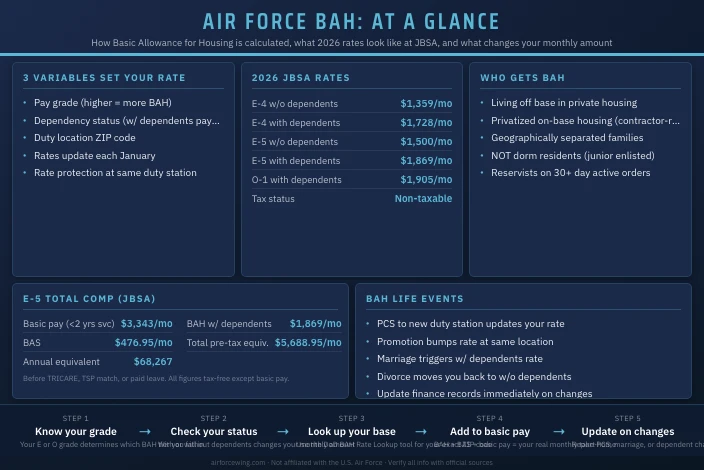
Three variables set your rate:
- Pay grade: higher grades receive more
- Dependency status: “with dependents” rates are higher than “without dependents”
- Duty location: the ZIP code of your primary duty station, not where you live
The DoD surveys local rental markets every year and sets BAH to cover the median rent for housing appropriate to your grade in that market. The intent is that you shouldn’t need to pay out of pocket for reasonable housing near your base.
One protection worth knowing: if BAH rates drop the following year, your rate will not decrease as long as your dependency status and duty station stay the same. This is called rate protection, and it has shielded Airmen at bases in cooling rental markets from sudden drops in take-home.
2026 Rates at a Major Installation
BAH varies widely depending on local housing costs. To show what the numbers look like in practice, here are 2026 rates for Joint Base San Antonio, TX: home to BMT, dozens of tech schools, and one of the largest concentrations of Airmen in the Air Force:
| Grade | Without Dependents | With Dependents |
|---|---|---|
| E-4 Senior Airman (SrA) | $1,359/mo | $1,728/mo |
| E-5 Staff Sergeant (SSgt) | $1,500/mo | $1,869/mo |
| O-1 Second Lieutenant (2d Lt) | $1,584/mo | $1,905/mo |
These reflect what DoD determined covers median rental costs in San Antonio’s housing market for each grade. A married SSgt at JBSA brings in $1,869/month just for housing, on top of basic pay and other allowances.
High cost-of-living bases, think Joint Base Pearl Harbor-Hickam in Hawaii or Travis AFB near San Francisco, show substantially higher BAH. Bases in lower-cost rural markets show lower rates. Use the DoD BAH Rate Lookup tool to find your specific installation and grade.
Who Qualifies and Who Doesn’t
Not every Airman receives BAH. The key question is whether government housing is available to you.
You typically receive BAH if you:
- Live off base in private housing you rent or own
- Live in privatized on-base housing (these units are run by private contractors and count as private housing for BAH purposes)
- Are in a situation where your family is geographically separated from your duty station (partial BAH rules apply)
You typically do not receive BAH if you:
- Live in a government-provided dormitory (most junior enlisted at their first duty station)
- Voluntarily decline available government quarters without an approved waiver
Junior Airmen fresh out of tech school often live in dorms and receive no BAH. Once they reach E-4 or E-5, marry, or have dependents, they commonly move off base and BAH kicks in. That transition is one of the bigger compensation jumps in the early career.
How Dependency Status Affects the Numbers
“With dependents” means you have a spouse, child, or other qualifying dependent. The with-dependents rate is higher because a family needs more space than a single Airman. At JBSA, an E-4 with dependents receives $369 more per month than an E-4 without. Over a 12-month year, that’s $4,428 in additional tax-free housing allowance.
The important rule: only one service member in a dual-military couple receives BAH with dependents. If both spouses are active duty and they have no children, each receives the without-dependents rate. If they have a child, one of them may claim the with-dependents rate.
BAH and Your Total Compensation Picture
BAH is not a bonus or a perk, it’s a core component of military compensation designed to make your actual take-home competitive with civilian salaries. When comparing an Air Force career to a civilian job offer, add BAH to your basic pay before making the comparison.
A new SSgt (E-5) at JBSA with dependents earns:
| Component | Monthly | Annual |
|---|---|---|
| Basic pay (less than 2 years) | $3,343 | $40,116 |
| BAH with dependents (JBSA) | $1,869 | $22,428 |
| BAS (Basic Allowance for Subsistence) | $476.95 | $5,723.40 |
| Total pre-tax equivalent | $5,688.95 | $68,267.40 |
That’s before factoring in free healthcare through TRICARE, paid leave, or the Thrift Savings Plan match. The Air Force pay and benefits guide covers the full compensation picture in one place.
What Changes BAH During Your Career
BAH is not a static number. Several events will change what you receive:
- PCS (Permanent Change of Station): Your rate updates to reflect the new duty location. Moving from a low-cost base to a high-cost-of-living base typically increases BAH. Moving the other direction decreases it, though rate protection limits downward adjustments.
- Promotion: A higher pay grade means a higher BAH rate at the same location.
- Marriage or adding a dependent: Triggers a change from without-dependents to with-dependents rates. You must update your records promptly through your unit’s finance office.
- Divorce or dependent loss: Moves you back to the without-dependents rate.
Update your personnel records immediately when your dependency status changes. BAH is paid prospectively, if you delay updating, you may receive the wrong rate and owe a debt to finance.
Reservists and Guard Members
BAH for Air Force Reserve and Air National Guard members works differently. You only receive BAH for days you are on active duty orders. During drill weekends, you generally do not receive BAH. When activated for extended periods, deployments, training exercises lasting 30 days or more. BAH kicks in at the same rates as active duty.
One exception: reservists who are activated on orders exceeding 30 days may qualify for BAH even if they own a home and have no dependent living in a rental property. The rules here get specific, so check with your unit finance officer when activation orders arrive.
This site is not affiliated with the U.S. Air Force or any government agency. Verify all information with official Air Force sources before making enlistment or career decisions.
For a broader look at everything the Air Force pays and provides, the complete Air Force pay and benefits guide is the right starting point. The Air Force benefits guide covers BAH alongside healthcare, education, and retirement in one place. You may also find Post-9/11 GI Bill benefits for Air Force members and how TRICARE works for active duty Airmen helpful for planning your full compensation picture. Browse Air Force enlisted careers to see how different AFSC assignments affect where you’re stationed and what BAH rates to expect.