Air Force Aviation Jobs: Enlisted and Officer
Aviation is the core of what the Air Force does. Whether you want to fly a fighter jet, keep one airworthy on the flightline, or guide aircraft through contested airspace from a ground station, there is an Air Force career built around that mission. This guide covers every major aviation path, officer rated positions and the enlisted jobs that support, crew, and maintain the aircraft.
Officer Aviation: The Rated Career Fields
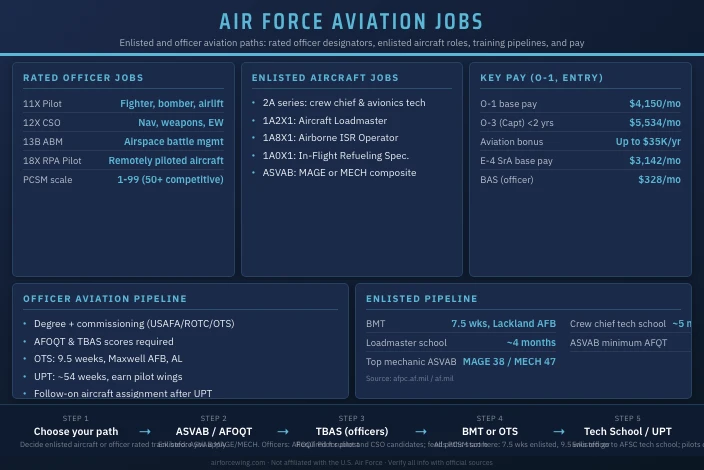
Rated officer positions are the flying jobs. The Air Force groups them under four primary designators, each tied to a different aviation mission. All four require a college degree, a commission, and competitive scores on the Air Force Officer Qualifying Test (AFOQT).
11X: Pilot
The 11X designator covers all fixed-wing pilots. Specific aircraft assignments determine the sub-designator (11F for fighter, 11B for bomber, 11C for airlift, and others). New pilots do not choose their aircraft directly, the Air Force assigns them based on class ranking, performance, and needs of the service.
Pilot candidates must score competitively on the AFOQT Pilot subtest and complete the Test of Basic Aviation Skills (TBAS). TBAS results feed into the Pilot Candidate Selection Method (PCSM) score, which boards use to rank applicants. PCSM scores run from 1 to 99. A score of 25 is the minimum competitive threshold; 50 or above puts you in a strong pool.
Entry-level pay for a new Second Lieutenant (O-1) starts at $4,150 per month in base pay. By Captain (O-3) with under two years at that grade, base pay reaches $5,534 per month. Aviation career incentive pay and retention bonuses, which can reach $35,000 per year for experienced pilots, stack on top of basic pay.
12X: Combat Systems Officer
Combat Systems Officers (CSOs) fly in the back seat. They operate weapons systems, electronic warfare suites, and navigation equipment on aircraft like the B-52, B-1, F-15E, and AC-130. It is a technically demanding job with direct responsibility for delivering weapons on target.
CSO candidates take the same AFOQT but focus on the Navigator-Technical subtest. TBAS is also required. Training follows a path similar to pilots but branches into specialized aircraft systems schooling rather than stick-and-rudder instruction.
13B: Air Battle Manager
Air Battle Managers (ABMs) do not fly the aircraft, they direct them. ABMs manage airspace, coordinate joint air operations, and control aircraft from airborne platforms like the E-3 Sentry AWACS or E-8 JSTARS. The job requires sharp situational awareness and the ability to process large amounts of sensor data under pressure.
In a contested environment, an ABM coordinates the movements of multiple aircraft simultaneously while tracking threats and communicating with ground and surface forces. The role carries command-level responsibility for how airpower is applied within a given area of operations.
AFOQT scores are required, though the specific subtest emphasis differs from pilot or CSO candidates. ABMs commission through the same paths (USAFA, AFROTC, OTS) and complete Officer Training School (OTS) at Maxwell AFB, Alabama if they come through the OTS route.
18X: Remotely Piloted Aircraft Pilot
RPA pilots fly the Air Force’s remotely piloted aircraft, including the MQ-9 Reaper, from ground control stations. The designation is 18X. Despite the remote format, RPA pilots hold the same commission as manned aircraft pilots and go through a similar selection and training pipeline.
RPA billets have grown significantly as the Air Force’s demand for persistent surveillance and strike capability has expanded. For candidates who want to fly operationally but prefer a ground-based assignment, 18X is worth serious consideration.
How Officers Get into Aviation
The path from civilian to rated officer follows a defined sequence. Each step is a gate, failing one closes the door to the ones that follow.
For a deep dive on TBAS and how to build a competitive PCSM score, the Air Force TBAS test guide covers preparation strategy, what each subtest measures, and what competitive scores actually look like on a selection board.
Enlisted Aviation: The Aircraft Workforce
Thousands of enlisted airmen keep Air Force aircraft flying. Some work directly on the aircraft as crew members in the air. Most maintain, repair, and inspect aircraft on the ground. These jobs require strong mechanical and electrical aptitude, and several carry significant responsibility for aircraft airworthiness.
2A Series: Aircraft Maintenance
The 2A career field is the backbone of Air Force aircraft maintenance. Crew chiefs (2A3XX) own an aircraft, they are responsible for everything that happens to it on the ground, from preflight inspections to coordinating repairs. Avionics technicians (2A5XX, 2A6XX) troubleshoot and repair the electronic systems that modern aircraft depend on. Propulsion mechanics (2A6XX) specialize in jet engine systems.
The 2A series covers a wide range of platforms: fighters like the F-16 and F-35, bombers like the B-1 and B-52, cargo aircraft like the C-17, helicopters, tankers, and special operations aircraft all have dedicated maintenance career fields within this series. The specific AFSC determines what aircraft a maintainer works on and which technical school they attend.
ASVAB requirements vary by specific job within the 2A series. Crew chief positions typically require a MAGE score of 38 or a MECH score of 47. Avionics technicians generally need higher ELEC composite scores. These are skilled trade jobs, the Air Force invests months of technical school time into each maintainer, and the certification they earn has direct civilian market value.
Tech school for crew chiefs runs approximately five months, depending on the aircraft type and specific AFSC. Avionics training can run longer. All enlisted airmen first complete Basic Military Training (BMT) at Joint Base San Antonio-Lackland, 7.5 weeks before any specialty training begins.
1A2X1: Aircraft Loadmaster
Loadmasters fly on cargo aircraft like the C-130 and C-17. They plan loads, manage in-flight cargo operations, and conduct aerial delivery, including airdrop of equipment and personnel. The job involves a mix of logistics knowledge and physical work in a demanding aviation environment.
Every load must be calculated for weight and balance before the aircraft can take off safely. Loadmasters are trained to plan and inspect those loads, and they are responsible for in-flight adjustments if conditions change. On missions with airdrop, they operate the doors and direct the drop sequence.
Loadmaster school runs approximately four months at Little Rock AFB, Arkansas. The ASVAB composite requirement focuses on the GEND (General) score. Experienced loadmasters develop expertise that translates well to civilian freight and logistics aviation careers.
1A0X1: In-Flight Refueling Specialist
Boom operators on the KC-135 and KC-46 tankers fly every mission and are responsible for transferring fuel to receiver aircraft in flight. It is a precision job, the boom operator controls a rigid refueling boom from a prone position while the aircraft is flying at altitude and speed. Receiver aircraft fly in tight formation for the contact, and a bad approach can damage both aircraft.
Boom operators must also be ready to manage fuel transfer emergencies and communicate directly with receiver crews during the procedure. The job carries real consequence: a tanker mission can extend the range of strike aircraft, rescue helicopters, or surveillance platforms that cannot make it back to base without an air refuel.
The in-flight refueling AFSC (1A0X1) requires a GEND composite score. Tech school is at Altus AFB, Oklahoma. Boom operators regularly deploy with tanker units and accumulate significant flight hours over a career.
1A8X1: Airborne ISR Operator
Airborne Intelligence, Surveillance, and Reconnaissance operators fly on platforms like the RC-135 Rivet Joint. They collect signals intelligence in flight, requiring a high security clearance and strong analytical skills alongside the aviation environment. Missions can last many hours. ISR crews spend a lot of time at altitude focused on sensors and data feeds, not scenery.
The ASVAB requirements for 1A8X1 include high ELEC and GEND scores. A TS/SCI security clearance is generally required, which means a thorough background investigation is part of the selection process. Operators who later leave the service carry skills directly applicable to defense contractor and intelligence community jobs, often in roles that pay well above median civilian wages.
Other Aviation-Adjacent Enlisted Jobs
Several other enlisted roles keep the aviation mission running without being directly tied to a specific aircraft type:
- 1C1X1. Air Traffic Control: Ground-based and tower controllers who manage aircraft movement at Air Force installations
- 2M0X1. Missile and Space Systems: Maintenance on systems that overlap with aviation technology
- 1A6X1. Flight Attendant: Crew support on VIP and executive transport aircraft
- 2T2X1. Air Transportation: Movement of cargo and personnel through the airlift system
Pay and Benefits
Pay in aviation roles follows standard military pay tables based on rank and years of service. Enlisted airmen start at E-1 Airman Basic; most aviation maintenance roles see new airmen reach E-4 Senior Airman after completing tech school and initial qualification training.
Enlisted pay reference points (monthly base pay):
| Grade | Title | Entry Pay |
|---|---|---|
| E-3 | Airman First Class | $2,837 |
| E-4 | Senior Airman | $3,142 |
| E-5 | Staff Sergeant | $3,343 |
| E-6 | Technical Sergeant | $3,401 |
Officer pay reference points (monthly base pay):
| Grade | Title | Entry Pay |
|---|---|---|
| O-1 | Second Lieutenant | $4,150 |
| O-2 | First Lieutenant | $4,782 |
| O-3 | Captain | $5,534 |
| O-4 | Major | $6,295 |
These figures are 2026 base pay only. Officers in rated aviation careers can also qualify for Aviation Career Incentive Pay (ACIP), which increases based on years of aviation service. Experienced pilots and CSOs with 10+ years of rated time can earn substantially more through ACIP and retention bonuses.
All active-duty airmen also receive Basic Allowance for Housing (BAH), which varies by duty location and dependency status, and Basic Allowance for Subsistence (BAS): $328.48 per month for officers and $476.95 per month for enlisted.
Civilian Career Value
Aviation experience from the Air Force translates into some of the strongest post-service earning potential in the military. The civilian aviation industry actively recruits veterans with military flight experience, and the demand for both pilots and mechanics has been high for years.
For former pilots and CSOs, the path to an airline career is well established. Major airlines count military flight hours toward ATP certificate requirements. Many veterans use their Post-9/11 GI Bill benefits to complete an Airline Transport Pilot certificate after separating. Regional airlines often fast-track military applicants with relevant flight hours, and legacy carriers pay senior captains well over $300,000 per year.
For maintainers, FAA mechanic certificates are achievable after military service. The Air Force’s aircraft maintenance training meets or exceeds the experience requirements for an FAA Airframe and Powerplant (A&P) certificate, which opens doors to airline, MRO, and defense contractor maintenance jobs. A&P mechanics earn a median annual wage of around $75,000, with experienced specialists at major airlines earning well above that.
The GI Bill also covers A&P certificate programs if a veteran wants to complete the formal certification process at a civilian school after separating. Some programs run less than 18 months.
For airborne operators like loadmasters and ISR operators, civilian freight aviation, charter operations, and defense contractors provide direct career paths. The clearances and systems knowledge these airmen carry are valuable well beyond the uniform. Many ISR operators transition directly to defense intelligence roles where those clearances and mission experience are in short supply.
Choosing Between Enlisted and Officer Aviation
The right path depends on what you want to do and what you can qualify for. A few clear distinctions help frame the choice.
Choose officer (rated) if:
- You want to fly the aircraft as the primary operator
- You have a four-year degree or plan to complete one
- You are willing to commit to the AFOQT and TBAS preparation required
- You want the career trajectory and pay of a commissioned officer
Choose enlisted aircraft careers if:
- You want to work directly on or around aircraft without the officer commitment
- You have strong mechanical, electrical, or technical aptitude
- You want to enter the Air Force faster (no degree required for enlisted)
- You want trade skills with direct civilian market value
One thing worth knowing: some enlisted airmen do pursue officer commissioning later in their careers. An enlisted maintainer who earns a degree while serving can apply for OTS and commission as an officer. The AFOQT and TBAS requirements still apply, but the applicant arrives with years of Air Force and aircraft knowledge that many officer candidates lack.
Both tracks require significant dedication and provide meaningful career credentials. Maintenance roles are the foundation of every flight mission, no aircraft flies without qualified maintainers signing off on it. Whether you are aiming for wings or a wrench, aviation is one of the most technically rich career fields the Air Force offers.
This site is not affiliated with the U.S. Air Force or any government agency. Verify all information with official Air Force sources before making enlistment or career decisions.
Explore Air Force enlisted operations careers and Air Force officer operations careers for AFSC-level details, ASVAB score requirements, and full training pipelines. The Air Force TBAS test guide and Air Force ASVAB scores for rated officer positions go deeper on qualification requirements for aviation paths.
For a side-by-side comparison of the four rated officer designators, Air Force Pilot vs CSO vs ABM vs RPA breaks down how each mission, training path, and career trajectory differs. If the pilot track is your goal, how to become an Air Force pilot walks through every step from application to wings. Enlisted maintainers should read best enlisted AFSC jobs for working on aircraft for a ranked breakdown of maintenance and crew roles. The Air Force TBAS test guide goes deep on how to prepare for the test and what score you need to be competitive on a pilot selection board. And if you want to understand how the TBAS fits alongside other officer selection tests, Air Force officer selection tests covers the full picture.