Air Force ASVAB Retesting Rules and Timeline
Your ASVAB score isn’t necessarily final. The Air Force allows retesting, but the rules around wait times and score usage have tripped up more than a few enlistment candidates. Knowing how the policy works before you walk into MEPS can save you months of waiting for an unnecessary retest, or stop you from testing too soon and locking in a lower score.
How Many Times Can You Retest?
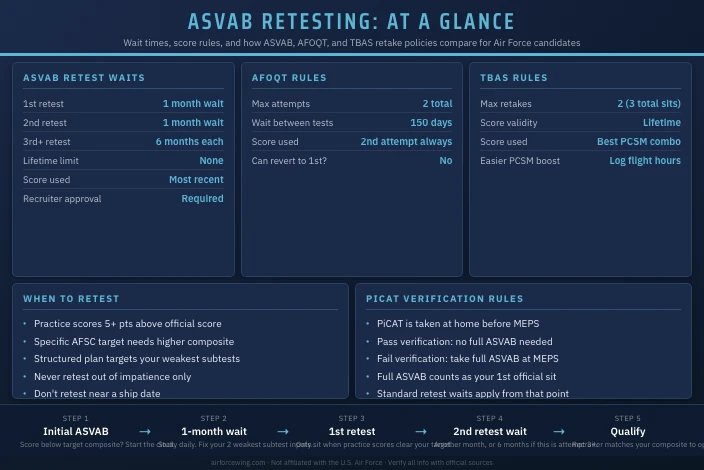
There is no lifetime cap on ASVAB retakes. You can test as many times as your recruiter authorizes. But the wait times between sittings get longer after the first two.
The standard schedule:
| Retest | Wait Time |
|---|---|
| 1st retest (after initial test) | 1 calendar month |
| 2nd retest (after 1st retest) | 1 calendar month |
| 3rd retest and beyond | 6 months between each sitting |
The third retest is where most candidates get surprised. If your initial score and your first retest both fall short, you still need to wait another month. But any sitting after that costs you six months per attempt. Plan your preparation around that timeline so you don’t burn an attempt unprepared.
Your recruiter must authorize each retest. They’ll want to see a clear reason, a specific AFSC target, a specific composite gap, and some evidence that your prep has changed. Walking in without a plan rarely gets approved.
The Score That Counts Is Your Most Recent
This is the most important rule and the most commonly misunderstood. The Air Force does not use your highest score. It uses your most recent score.
If you scored a 62 on your first test and a 54 on your retest, your qualifying score is now 54. The higher score is gone. There is no opt-out, no score banking, and no way to revert to an earlier sitting.
This changes the calculus completely. Retesting when you’re not ready doesn’t just waste a month or six months, it can drop you below an AFQT or composite threshold you already cleared.
The rule of thumb: only retest when your practice test scores are consistently running above your current official score. If your practice results are hitting the same range or lower, wait and study more before scheduling a retest.
PiCAT and What Happens If Verification Fails
The PiCAT (Pre-screening, internet-administered Computerized Adaptive Test) is an at-home version of the ASVAB that some recruits take before going to MEPS. If your PiCAT score meets the threshold, you take a 25-30 minute verification test at MEPS instead of the full exam.
The verification test is pass/fail. If you fail it, meaning your MEPS performance doesn’t match your at-home score, you take the full ASVAB at MEPS on the spot. That result becomes your official score.
A few things to keep in mind:
- The PiCAT is not a separate test with separate retake rules. It feeds into the same ASVAB score system.
- If you take the full ASVAB after a failed verification, that ASVAB counts as your first sitting.
- Standard retesting wait times apply from that point forward.
Don’t treat the PiCAT as a trial run. Study for it exactly as you would for the real ASVAB, because your score may end up being the official one.
AFOQT Retesting Rules
The Air Force Officer Qualifying Test (AFOQT) has stricter retake rules than the ASVAB.
Key policy points:
- You may take the AFOQT a maximum of two times.
- There is a mandatory 150-day wait between attempts.
- The second attempt score is your permanent official score, regardless of whether it is higher or lower than your first attempt.
That last rule is unusual and worth understanding fully. If you scored a 75 on your first AFOQT and a 68 on your second, your official score is 68. You can’t cancel the second attempt or fall back on the first. Retaking the AFOQT is a high-stakes decision.
Because of the two-attempt limit and the forced acceptance of the most recent score, most officer candidates treat the first AFOQT sitting as their real shot and use it only after thorough preparation.
TBAS Retesting Rules
The Test of Basic Aviation Skills (TBAS) is required for officer candidates pursuing rated positions: pilot, combat systems officer, and air battle manager. Its retake rules differ significantly from both the ASVAB and AFOQT.
| Rule | TBAS |
|---|---|
| Maximum retakes | 2 total (3 lifetime sittings) |
| Wait time between attempts | Varies; consult your unit or recruiter |
| Score validity | Scores are valid for life |
| Score used | Best combination factored into PCSM |
The lifetime validity is the major advantage over the ASVAB. If you took the TBAS years ago and want to reapply for a rated position, that score is still on record. You don’t need to retest unless you want to improve your PCSM score.
The PCSM (Pilot Candidate Selection Method) score is calculated from your TBAS results, your AFOQT Pilot subtest score, and your logged civilian flight hours. Getting more flight hours is often a more reliable way to raise PCSM than retaking the TBAS.
When to Retest vs. When to Accept Your Score
Retesting carries real risk because of the most-recent-score rule. Here’s how to think through the decision:
Retest if:
- Your practice test scores are running 5 or more points above your official score on a consistent basis
- You have a specific AFSC target that requires a higher composite and you have time to wait
- You have a structured study plan that addresses the exact subtests pulling your composite down
Don’t retest if:
- Your practice scores are landing around the same result as your official test
- You’re approaching a ship date and a lower retest score could delay your enlistment
- You haven’t changed what you’re studying or how you’re studying since the last attempt
The six-month window between third and later retests is a feature, not a punishment. Use it. Six months of consistent study, 30 to 45 minutes daily on your two weakest subtests, produces meaningful gains. The candidates who score highest on retests are the ones who treated the waiting period as mandatory prep time.
How the Timeline Plays Out in Practice
Say you take your initial ASVAB and fall 8 points short of the composite you need. Here’s a realistic timeline:
If your gap is large, 15 or more composite points, expect the process to take at least three to four months from your first test to a qualifying score. Building that timeline into your planning prevents the frustration of delays that are actually written into policy from the start.
The Air Force Officer Selection Tests post covers the AFOQT, TBAS, and PCSM in full detail for officer candidates. You may also find How to Raise Your ASVAB Line Scores and the Air Force ASVAB test prep guide useful as you plan your preparation and retesting approach. Browse Air Force enlisted careers to see the ASVAB composite requirements for each AFSC before you schedule a retest.