AFSC Jobs With the Biggest Signing Bonuses
The Air Force advertises enlistment bonuses up to $50,000. Most recruits never see that number. The ones who do chose jobs in career fields the Air Force genuinely struggles to fill. Knowing which AFSCs those are puts you in a far better position before you walk into a recruiting office.
This post covers which career fields have historically offered the biggest signing bonuses, what ASVAB scores you need to qualify, and how to position yourself for the highest possible payout.
Why Certain AFSCs Pay More
The Air Force uses bonuses as a staffing tool, not a reward. Jobs that require long, expensive training pipelines or rare skill sets are the hardest to keep filled. When manning levels drop below target, AFPC authorizes bonuses to attract recruits who are willing to commit.
Three factors drive bonus size more than anything else:
- Job criticality. If the Air Force can’t function without a skill set, it pays more to get people in that seat.
- Training pipeline length. A 14-month tech school is a bigger investment than an 8-week course. The Air Force needs to know you’ll stay.
- Contract length. Longer commitments qualify for higher tiers. A 6-year contract nearly always beats a 4-year contract for the same job.
Manning levels shift constantly. An AFSC that paid a $40,000 bonus last year might pay nothing this year if the Air Force overstaffed it during a strong recruiting cycle.
Cyber and Intelligence
Cyber and intelligence jobs consistently sit at the top of the bonus chart. The Air Force competes directly with the federal government and private sector for people who can do this work, and it loses that competition on salary alone. Bonuses help close the gap at the front door.
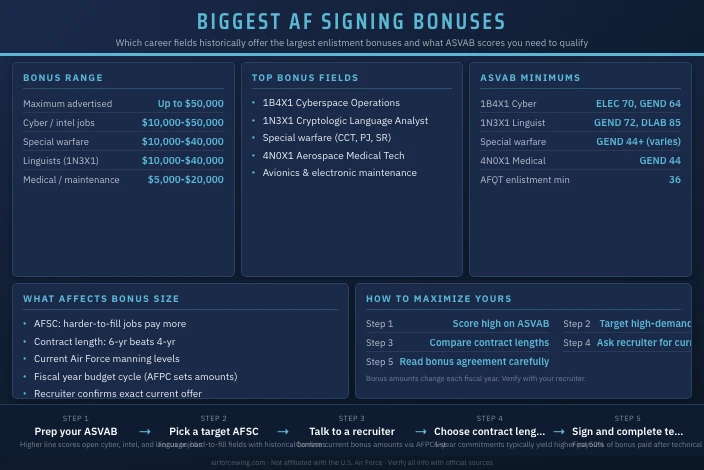
1B4X1 Cyberspace Operations is the enlisted cyber warfare specialty. It requires an ELEC composite of 70 and a GEND composite of 64, plus a Top Secret/SCI clearance. The training pipeline runs over a year between tech school phases at Keesler AFB and Hurlburt Field. Historical bonus ranges for 1B4X1 have reached $40,000 to $50,000 during high-demand periods.
1N1X1 Geospatial Intelligence (GEOINT) and 1N2X1 Signals Intelligence (SIGINT) analysts both require high GEND composites and a TS/SCI clearance. These jobs analyze imagery and signals data to support operational planning. They have appeared regularly on high-bonus lists because the clearance requirement alone filters out a significant portion of applicants.
1N3X1 Cryptologic Language Analyst has a longer and harder entry pipeline than almost any other enlisted job. On top of the ASVAB requirements, recruits must qualify on the Defense Language Aptitude Battery (DLAB) and then complete the Defense Language Institute’s intensive language program. The combination of rare aptitude, extended training, and high clearance requirements has historically produced bonuses in the $10,000 to $40,000 range, depending on the language being trained.
When you purchase through links on our site, we may receive compensation at no extra cost to you.
Cyber and intelligence jobs set some of the highest ASVAB line score thresholds in the Air Force. An ASVAB prep course targets the specific subtests that feed those composites. If the ELEC or GEND score is what stands between you and a high-bonus AFSC, targeted prep is worth the investment.
Special Warfare
Special warfare careers are a category of their own. The pipeline for 1C2X1 Combat Controller (CCT), 1T2X1 Pararescue (PJ), and 1Z0X1 Special Reconnaissance (SR) involves multiple selection gates, water survival training, airborne school, and often a year or more of sequential courses before you earn your beret or badge.
Attrition rates are high. The Air Force loses a significant percentage of candidates at each pipeline phase. To keep the pipeline fed, bonuses for these specialties have historically been substantial, with some reaching $40,000 or more for recruits who commit to a 6-year contract.
The entry ASVAB bar varies by specialty but is lower than most people expect. Combat Controller requires a GEND composite of 44. The physical standards and mental toughness requirements do far more filtering than the written test. That said, a higher AFQT score signals academic capability and keeps more doors open during MEPS processing.
One other factor: special warfare jobs carry hazardous duty incentive pay and combat pay on deployment, which stack on top of any enlistment bonus. The total compensation picture over a 6-year contract is meaningfully higher than the signing bonus figure alone suggests.
Linguists and Foreign Area Specialists
Language jobs attract large bonuses for a simple reason: trained military linguists are genuinely hard to find and take years to produce. The 1N3X1 pipeline (mentioned above in intelligence) is the primary enlisted language path, but there are other language-dependent AFSCs that appear on bonus lists depending on current mission requirements.
The languages that command the highest bonuses tend to be the ones with the fewest native English speakers who also qualify for military service: Arabic, Chinese Mandarin, Korean, Pashto, Farsi, Russian. The Air Force publishes annual language needs lists through AFPC, and demand shifts with geopolitical priorities.
If you have a background in any of these languages, even conversational proficiency, mention it early in the recruiting process. Prior exposure significantly improves DLAB scores and shortens the training pipeline, both of which make you more valuable to a recruiter trying to fill a language requirement.
Medical and Allied Health
Medical AFSCs don’t always generate the headline numbers that cyber jobs do, but they appear on bonus lists with regularity because qualified candidates are hard to retain. Someone who completes tech school as an 4N0X1 Aerospace Medical Technician or 4J0X2 Physical Medicine Technician has skills that translate directly to civilian EMT, medical assistant, or physical therapy aide roles. The Air Force competes with those civilian options for every person it trains.
Historically, medical technician AFSCs have offered bonuses in the $5,000 to $20,000 range during periods of low manning. These aren’t the largest numbers on the list, but the jobs themselves offer strong post-service career value that compounds the upfront bonus.
The entry requirement for 4N0X1 is a GEND composite of 44. That’s achievable for most applicants who prepare adequately for the ASVAB. It also means qualifying for this job doesn’t require top-percentile scores, unlike the cyber and intelligence fields above.
Aviation Maintenance and Avionics
Maintenance careers don’t generate the same press as cyber or special warfare, but they consistently appear on bonus-eligible lists. The Air Force runs one of the largest and most technically complex fleets in the world. Keeping it flying requires a steady supply of skilled technicians.
2A3X3 Tactical Aircraft Maintenance and 2A6X6 Aerospace Propulsion (among others) require strong MECH composites and involve hands-on training with aircraft systems that take years to master. Avionics specialties like 2A0X1 Avionics Test Station and Components sit at the intersection of mechanical and electronics skills and often qualify for the higher ELEC-based composites.
Bonus amounts for maintenance AFSCs have historically ranged from $5,000 to $20,000, skewing higher for avionics and complex systems work. Contract length matters more in this category than in most others. A 6-year commitment signals that you’ll actually develop into a productive technician before you’re eligible to separate.
How ASVAB Scores Open Bonus-Eligible Jobs
Your AFQT score gets you in the door. The minimum to enlist in the Air Force is 36. But the AFQT alone doesn’t determine which jobs you qualify for. Air Force jobs are gated by six composite line scores: MAGE, ELEC, MECH, ADMI, and GEND, each drawn from specific ASVAB subtests.
Here’s how the highest-bonus fields map to those composites:
| Career Field | Key Composite | Typical Minimum |
|---|---|---|
| Cyberspace Operations (1B4X1) | ELEC | 70 |
| Cryptologic Language Analyst (1N3X1) | GEND | 72 |
| Intelligence (1N1X1, 1N2X1) | GEND | 64-72 |
| Aerospace Medical Tech (4N0X1) | GEND | 44 |
| Combat Controller (1C2X1) | GEND | 44 |
| Avionics (2A0X1) | ELEC | 60+ |
| Aircraft Maintenance | MECH | 47-56 |
If your current scores fall short of the threshold for your target AFSC, the gap is almost always closable with focused prep. The ELEC and GEND composites are most relevant for the highest-bonus jobs. Both draw heavily from the Electronics Information, Arithmetic Reasoning, and Mathematics Knowledge subtests. Drilling those specific areas will move your line scores faster than general ASVAB review.
Visit Air Force ASVAB test prep for a targeted study plan built around the composites that matter most for high-demand AFSCs.
What to Ask Your Recruiter
Bonus lists change. The information in this post reflects historical patterns, not a current offer. Before you commit to a job, get answers to these specific questions:
- Is this AFSC currently on the bonus-eligible list?
- What is the exact bonus amount for a 4-year versus 6-year contract?
- When is the bonus paid, and what are the repayment conditions?
- Does the bonus appear as a line item in my enlistment contract?
That last question matters. If a bonus is promised verbally but not in the contract, it doesn’t exist. Every dollar amount your recruiter mentions should be reflected in writing before you sign.
For a full breakdown of how bonus payments are structured, see Air Force Enlistment Bonuses: How They Work and Air Force Bonus for High ASVAB Scores.
Explore all enlisted career fields at Air Force Enlisted Careers to find which AFSCs fit your scores and interests.