AFOQT Minimum Scores by Career Field
When you purchase through links on our site, we may receive compensation at no extra cost to you.
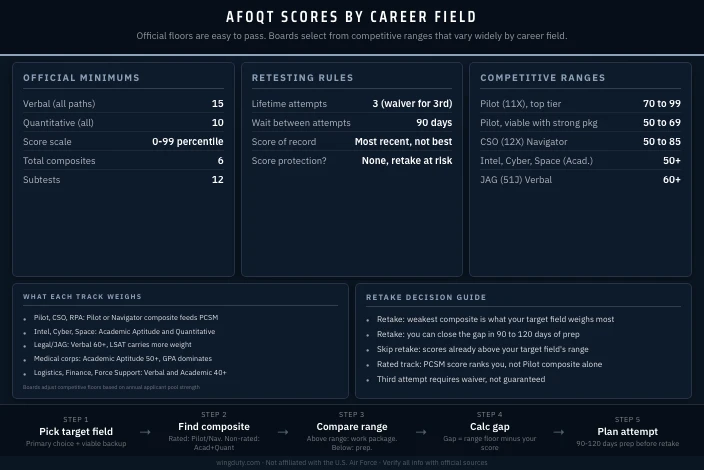
The Air Force publishes two AFOQT minimums: Verbal 15 and Quantitative 10. Those numbers keep nearly everyone in the game. They tell you almost nothing about what it takes to actually get selected. Every officer career field runs its own board, and each board leans on different composites at different competitive ranges. Where you need to score depends entirely on what you want to do.
The 5 Composites That Drive Selection
The AFOQT produces 6 total composites, but one of them, the ABM composite, applies only to Air Battle Manager candidates. The remaining 5 appear on every officer’s score sheet.
| Composite | What It Measures | Used By |
|---|---|---|
| Pilot | Math, spatial reasoning, aviation knowledge | Pilot (11X) boards; feeds PCSM |
| Navigator/CSO | Spatial reasoning, table reading, instrument knowledge | CSO (12X) and ABM (13B) boards |
| Academic Aptitude | Verbal and quantitative combined average | All officer programs; general baseline |
| Verbal | Word knowledge and reading comprehension | All officer programs; floor is 15 |
| Quantitative | Arithmetic, data interpretation, math knowledge | All officer programs; floor is 10 |
These composites come from 12 subtests. Subtest scores feed multiple composites, so improving on one subtest, Arithmetic Reasoning, for example, moves your Quantitative, Academic Aptitude, and indirectly your Pilot composite at the same time.
The Verbal and Quantitative floors exist to confirm that candidates can handle the academic workload of officer training. Passing those floors is easy. The real competition happens at the career-field level.
Official Minimums vs. Competitive Ranges
Understanding the difference between the official threshold and what boards actually select matters before you set a score target.
Official minimums are the published floors for commissioning eligibility. Score at or above these and your application isn’t auto-rejected:
- Verbal: 15
- Quantitative: 10
Competitive ranges are the score bands where most board-selected candidates actually land. These are not published by the Air Force, but officer accessions data, recruiter guidance, and selection board patterns show consistent bands across career field categories.
| Career Field Category | Key Composites | Competitive Range |
|---|---|---|
| Pilot (11X) | Pilot | 70-99 (top tier); 50-69 (competitive with strong package) |
| CSO (12X) | Navigator/CSO | 50-85 (boards less competitive than pilot) |
| RPA Pilot (18X) | Pilot | 50-75 (PCSM also required) |
| ABM (13B) | ABM, Navigator/CSO | 50-80 |
| Intelligence (14N/14F) | Academic Aptitude, Verbal | 50+ Academic Aptitude; Verbal 40+ |
| Cyber (17D/17S) | Academic Aptitude, Quantitative | 50+ Quantitative |
| Space (13S) | Quantitative, Academic Aptitude | 50+ Quantitative |
| Logistics (21A/21R) | Academic Aptitude, Verbal | 40+ across both |
| Civil Engineering (32E) | Quantitative | 45+ Quantitative preferred |
| Finance/Contracting (64P/65F) | Quantitative, Verbal | 45+ across both |
| Medical (corps officers) | Academic Aptitude, Verbal | 50+ across both; GPA carries more weight |
| Legal/JAG (51J) | Verbal | 60+ Verbal; LSAT also required |
| Public Affairs (35P) | Verbal | 50+ Verbal; writing sample matters more |
| Chaplain (52R) | Verbal, Academic Aptitude | 40+; seminary credentials weigh heavily |
| Force Support (38F) | Academic Aptitude, Verbal | 40+ across both |
These ranges reflect historical patterns. Boards adjust based on year-to-year applicant pool strength and Air Force manning priorities. A year with high pilot applicant volume raises the competitive floor. A year with manning shortfalls in a specific field can lower it.
How Boards Weight Composites by Career Field
Not every board reads the score sheet the same way. Career-field boards have specific priorities that shape how composites factor into a selection decision.
Rated Aviation Boards
Pilot and CSO boards weight the aviation-specific composites most heavily. The Pilot composite feeds directly into the PCSM score, which is the primary ranking tool for Undergraduate Pilot Training selection boards. A strong Pilot composite with a weak Academic Aptitude score is far less damaging than the reverse.
For CSO candidates, the Navigator/CSO composite carries more weight than the Pilot composite. Both rated tracks require the TBAS (Test of Basic Aviation Skills) and use PCSM for final ranking. Test scores matter, but the PCSM is the number boards sort by.
RPA (18X) boards function similarly to pilot boards. They require TBAS and calculate PCSM. Candidates who cannot get a competitive Pilot composite or PCSM for 11X sometimes find 18X a more accessible rated path, though boards have grown more selective as RPA demand has increased.
Non-Rated Operations and Technical Fields
Intelligence, Cyber, Space, and similar technical officer fields weight Academic Aptitude heavily. These boards evaluate whether a candidate can handle the analytical demands of the career field. Verbal still counts, because officers brief, write, and present regularly, but a Quantitative score in the 50s with Academic Aptitude in the 60s will usually outperform the reverse for a Cyber application.
Civil Engineering and Contracting boards care about math fluency. A strong Quantitative score signals the foundation for technical problem-solving and contract analysis. Board reviewers for these fields often come from STEM or acquisitions backgrounds and interpret the Quantitative composite as a proxy for whether you can keep up.
Professional Corps and Support Fields
Legal (JAG), Public Affairs, and Medical corps boards use AFOQT composites differently. These fields have additional credentialing requirements, a law degree, medical degree, or strong writing portfolio, that often carry more weight than test scores. A JAG candidate with a 60 Verbal and a 145 LSAT is more competitive than one with a 75 Verbal and a 155 LSAT.
Public Affairs boards read the Verbal composite as a signal but evaluate writing samples, internship history, and communications experience more directly. Chaplain candidates face similar dynamics: academic credentials from a seminary program and endorsement from a religious organization weigh more than composite scores.
That said, scoring below 40 on any composite in these fields creates friction even when other credentials are strong. Boards don’t want to explain a selection where every score is below the cohort average.
Rated Track Scores in Detail
Pilot, CSO, RPA, and ABM are the most score-sensitive tracks in the Air Force officer corps. Every number on your package gets examined.
Pilot (11X)
The Pilot composite is built from these subtests: Instrument Comprehension, Table Reading, Arithmetic Reasoning, Mathematics Knowledge, and Scale Reading.
| Pilot Composite | What to Expect |
|---|---|
| Below 25 | Difficult to get a board review |
| 25-49 | Minimum competitive; every other factor must be strong |
| 50-74 | Solid candidate range |
| 75-99 | Top-tier; boards notice |
The PCSM score, which combines AFOQT Pilot subtest with TBAS scores and logged civilian flight hours, ultimately determines your ranking. A Pilot composite in the 80s with a PCSM of 45 is not as strong as a Pilot composite of 70 with a PCSM of 65. Focus on PCSM, not the Pilot composite alone.
CSO (12X) and ABM (13B)
CSO and ABM boards use the Navigator/CSO composite. That composite draws from Navigation (spatial reasoning), Table Reading, Instrument Comprehension, and Arithmetic Reasoning.
CSO boards have historically been less competitive than pilot boards. A Navigator/CSO score in the 50s, paired with a solid Academic Aptitude score and a strong leadership record, produces a viable package. ABM boards add an ABM-specific composite that draws from similar subtests.
RPA Pilot (18X)
RPA selection uses the Pilot composite and PCSM. The competitive ranges are slightly lower than for 11X, but the gap has narrowed as demand for unmanned systems experience has grown. Treat the score targets the same as pilot and let the board’s acceptance rate guide expectations.
Retake Math: 3 Attempts, 90-Day Wait
The Air Force authorizes three AFOQT administrations over a candidate’s lifetime. The rules:
- 90-day wait required between attempts
- Third administration requires a waiver
- The most recent attempt is the score of record (not the best; not super-scored)
That last point separates the AFOQT from many competitive tests. Retaking without meaningful preparation does not protect your best score. A weaker second attempt replaces your first one. Candidates who scored 72 on the Pilot composite on attempt one and then scored 65 on attempt two are now a 65.
The waiver for a third attempt is not automatic. Many candidates never get it approved. Treat your first attempt as your best opportunity and your second as your final realistic attempt.
Who Should Retake
A retake makes sense when:
- Your weakest composite is the one your target career field weights most heavily
- You can identify specific subtests that dragged that composite down
- You have 90 days to address those specific gaps before the next attempt
- The score difference needed is realistic (a 20-point jump is ambitious; a 10-point jump is achievable with disciplined prep)
A retake does not make sense when your scores are above the competitive range for your target field. No pilot board turns away a package because the candidate scored 88 instead of 92.
AFOQT Online Preparation Course
The AFOQT online preparation course offers video instruction for all 12 subtests, timed practice tests, and targeted drills for the spatial reasoning sections that most candidates underestimate. Worth using before your first attempt.
How to Read Your Score Sheet Against This Table
When you receive your AFOQT results, run through this decision sequence before setting any prep or retake plan.
Identify your target career field
Pin down your first-choice field. If you have a primary choice (pilot) and a realistic backup (intelligence), note both. You’ll need to satisfy the competitive range for each one.
Pull the composites that board uses
Rated tracks: Pilot or Navigator/CSO plus Academic Aptitude. Non-rated technical fields: Quantitative and Academic Aptitude. Support and professional corps: Verbal and Academic Aptitude. Use the table above to match field to composite.
Compare your scores to the competitive range
If you’re above the range for your target field, test scores are done. Work on GPA, fitness, and leadership documentation. If you’re in range, evaluate whether other package factors are strong enough to carry you. If you’re below range, a retake with targeted prep is the next move.
Calculate the retake math
Subtract your current composite from the bottom of the competitive range. That gap is what you need to close. Identify which subtests feed that composite using the subtest-to-composite map in your AFOQT test prep resource. Prioritize those subtests in your study plan.
Decide on attempt timing
The 90-day wait is a minimum, not a recommendation. Most candidates benefit from 90 to 120 days of structured preparation before a retake. Don’t burn an attempt chasing a marginal improvement.
Non-Rated Fields: Scores That Get You Across the Line
Non-rated officer candidates often underinvest in AFOQT preparation because they hear that scores matter less than GPA and leadership. That’s partially true at the top of the field, where boards have deep applicant pools with strong scores. It’s less true at the margin, where a below-average composite can become the differentiating factor.
For Intelligence, Cyber, and Space: an Academic Aptitude score above 50 and a Quantitative score above 45 clears the score threshold that most boards consider acceptable. The whole-person review then takes over.
For Logistics, Finance, and Force Support: Verbal and Academic Aptitude in the 40s are workable, but 50+ on both composite types removes any doubt. These fields commission officers who write, brief, and manage people, and boards interpret Verbal as a proxy for communication ability.
For Legal and Medical corps: the relevant professional credentials, LSAT, USMLE, MCAT, carry more selection weight than AFOQT composites. Still, scoring below 40 on any composite signals a gap that boards will flag.
The officer qualification guide has full eligibility requirements for each commissioning path, including GPA minimums, degree requirements, and age limits by career field.
Connecting Scores to the Right Career Path
AFOQT scores are one filter among several. Candidates who build their career search around score targets alone sometimes end up applying to fields that don’t fit their background, physical standards, or long-term goals.
A more useful approach: match your interests and background to two or three career fields, check the composite requirements for each, and set a score target that clears the competitive range for your top choice while keeping backup options viable.
For rated fields, visit Air Force Operations Officer Careers to see the specific AFSC codes, mission descriptions, and requirements for each aviation track. For non-rated fields, the complete officer career directory gives you the same breakdown by field.
You may also find Air Force Officer Selection Tests and Best ASVAB Scores for Rated Officer Positions useful as you build out your full preparation timeline.