Active Duty vs Air Force Reserve vs Air National Guard
Three different ways to serve in the Air Force. Same uniform, same ASVAB, same basic training, but the day-to-day life looks nothing alike. Most people pick a component based on one factor, then spend years wishing they’d known the full picture upfront.
Active duty is a full-time job with a paycheck, housing, and healthcare from day one. The Reserve and Air National Guard let you keep your civilian career while maintaining a military commitment. Each path has real trade-offs, and the right answer depends on what you want your life to look like for the next four to twenty years.
This guide breaks down every major difference between the three components so you can make an informed decision before you sign anything.
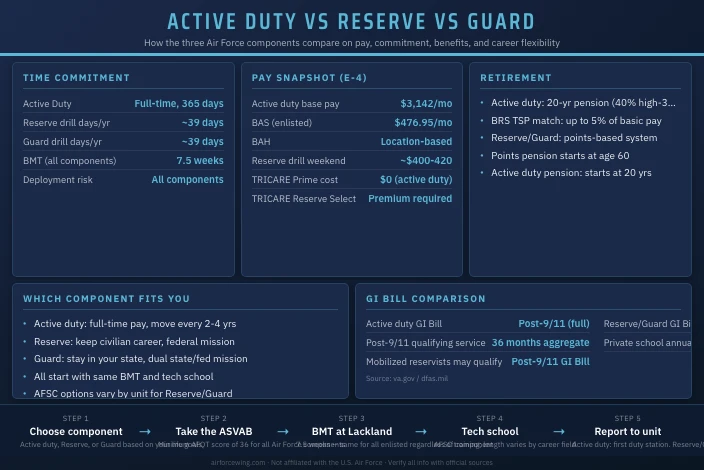
The Three Air Force Components
The Air Force operates through three distinct components, each with its own command structure, funding source, and readiness mission.
Active Duty is the full-time force. Airmen live on or near a base, work standard military schedules, and can be deployed anywhere in the world on short notice. Active duty airmen fall under the Department of the Air Force and are available 24/7.
Air Force Reserve (AFR) is the federal reserve component. Reserve airmen typically serve one weekend per month and two weeks per year during what’s called “drill.” The Air Force Reserve Command (AFRC) manages these units, and Reserve airmen can be mobilized for federal missions including overseas deployments.
Air National Guard (ANG) is a dual-mission force. Each state has its own Air National Guard, which serves the state governor during emergencies like natural disasters. The Guard can also be federalized for national missions. Guard members drill on a similar schedule to reservists but answer to their state’s adjutant general during peacetime.
Understanding which command controls your unit matters. Reserve units deploy for federal missions. Guard units can be deployed by the governor for state emergencies or by the President for federal ones.
Time Commitment Compared
The most visible difference between these paths is how much of your life the military owns.
| Component | Weekly Obligation | Annual Active Duty Days | Deployability |
|---|---|---|---|
| Active Duty | Full-time (40+ hrs/week) | 365 | Frequent, often 6-12 month rotations |
| Air Force Reserve | ~2 days/month | ~39 days | Varies; mobilizations possible |
| Air National Guard | ~2 days/month | ~39 days | Varies; state + federal missions |
Active duty is straightforward. You report to work every weekday. Deployments, TDY (temporary duty) travel, and exercises add time beyond standard work hours regularly.
Reserve and Guard service runs on the “one weekend a month, two weeks a year” model, but that understates the real commitment. Many AFSCs require additional training events, readiness exercises, and voluntary activations throughout the year. Some Guard and Reserve units are in high operational demand and deploy almost as often as their active duty counterparts.
What this means practically: Active duty works best if you want structure, a steady paycheck, and don’t mind relocating every few years. Reserve and Guard work best if you have a civilian career, family ties to a specific area, or want to serve without uprooting your life.
Pay: What Each Component Actually Pays
Pay structure is where the components diverge most sharply. The differences aren’t just about amount. They’re about when and how you get paid.
Active Duty Pay
Active duty airmen receive monthly basic pay, plus allowances that are non-taxable and substantial. An E-4 Senior Airman earns $3,142 per month in basic pay at less than two years of service, per the 2026 DFAS military pay tables. Add the Basic Allowance for Housing (BAH, which varies by installation and dependency status) and the Basic Allowance for Subsistence (BAS, $476.95 per month for enlisted), and total compensation climbs well above the basic pay figure.
Active duty airmen also receive full TRICARE Prime healthcare at no premium, base exchange access, commissary access, and 30 days of paid vacation per year.
Reserve and Guard Drill Pay
Reserve and Guard members earn drill pay only on the days they serve. Drill pay uses the same pay tables as active duty, but a standard drill weekend counts as four drill periods (two per day). Pay grade and years of service determine the rate.
An E-4 with less than two years of service earns $3,142 per month on active duty. That same E-4 at a drill weekend earns roughly four times the daily active duty rate, which works out to about $400 to $420 per weekend.
During annual training (the two-week requirement), Reserve and Guard members receive full active duty pay plus allowances for that period.
Reserve and Guard Benefits
Part-time service comes with part-time benefits. Reserve and Guard members do not automatically receive BAH or BAS outside of activation periods. Healthcare is available through TRICARE Reserve Select, a premium-based plan, rather than the zero-cost TRICARE Prime that active duty members receive.
The GI Bill situation is also different. Active duty members earn the Post-9/11 GI Bill after 36 months of aggregate active service (or 30 continuous days if discharged for a service-connected disability). Reserve and Guard members can access the Montgomery GI Bill - Selected Reserve (MGIB-SR), which pays a lower monthly benefit than the Post-9/11 GI Bill. However, reservists who are mobilized under Title 10 orders may eventually qualify for Post-9/11 GI Bill benefits.
| Benefit | Active Duty | Reserve / Guard |
|---|---|---|
| Basic Pay | Full-time monthly | Drill periods only |
| BAH | Yes (location-based) | Only during activation |
| BAS | $476.95/month (enlisted) | Only during activation |
| Healthcare | TRICARE Prime (no premium) | TRICARE Reserve Select (premium) |
| GI Bill | Post-9/11 GI Bill (after qualifying service) | MGIB-SR (lower benefit) |
| Leave | 30 days/year | Not applicable |
| Retirement | 20-year pension (BRS) | Points-based (different system) |
For a detailed look at what each benefit package includes, the Air Force benefits guide covers current figures.
Retirement: Two Very Different Systems
This is the detail most people miss when they compare the components.
Active duty retirement under the Blended Retirement System (BRS) pays a pension after 20 years of active service. The monthly pension equals 2% of your high-36 average basic pay times years of service, so 20 years equals 40% of high-36 pay. TSP matching of up to 5% of basic pay starts from day one.
Reserve and Guard retirement uses a points-based system. You earn retirement points for each drill, day of active duty, and other qualifying activities. The formula converts those points into equivalent active duty years, then applies the same 2% multiplier. But the pension doesn’t start paying until age 60 (or earlier if you deployed under certain mobilization orders). That means you can complete 20 “qualifying years” in your 30s and not see a penny until you’re 60.
For someone choosing between active duty and Reserve service at age 22, that 28-year gap between earning retirement eligibility and receiving the pension is worth real thought.
Career Flexibility and Location
Active duty airmen go where the Air Force sends them. Permanent Change of Station (PCS) moves happen every two to four years on average. You might start in Texas, move to Germany, then land in Alaska. The Air Force decides.
Reserve and Guard service solves the location problem. You join a specific unit, and that unit stays where it is. Guard units are embedded in their states, often in smaller cities that don’t have active duty bases. If you want to stay in your hometown, be near family, or build roots somewhere specific, the Guard or Reserve makes that possible in a way active duty doesn’t.
The flip side: your AFSC options are limited to what your local unit needs. Active duty offers access to all 150-plus enlisted AFSCs across dozens of installations worldwide. Reserve and Guard openings depend on what’s available in your region. Some rare or highly technical AFSCs simply don’t exist in every state’s Guard.
Training Pipeline: Shared Start, Different Paths
Regardless of which component you choose, the entry pipeline is the same.
Officer entry follows a similar pattern. Active duty officers commission through ROTC, the Air Force Academy, or Officer Training School (OTS) at Maxwell AFB, AL. Guard and Reserve officers follow similar commissioning paths, though some may receive direct commissions depending on their professional background.
Deployment Risk: More Than Just Weekends
One of the biggest misconceptions about Reserve and Guard service is that part-time equals non-deploying. That’s not accurate.
Reserve and Guard units have been deployed continuously to combat and contingency operations for over two decades. Some specialties, particularly those in intelligence, special operations support, medical, and civil engineering, see mobilization rates that rival active duty units.
The frequency of mobilization depends on your AFSC, your unit’s mission, and the operational environment at the time you serve. When you talk to a recruiter, ask specifically about the deployment history of the unit you’re considering, not just the general Reserve or Guard policy.
Active duty airmen face more predictable deployment cycles, though the predictability cuts both ways: you know deployments are coming, and you can’t easily opt out of them based on civilian job or family commitments.
Which Component Fits Which Life
No component is objectively better. The right choice depends on your situation.
Active duty fits you if:
- You want full-time employment with no civilian job to balance
- You’re comfortable with geographic mobility every 2-4 years
- You want maximum access to AFSCs and career development opportunities
- You want the full benefits package from day one (housing, healthcare, leave)
Air Force Reserve fits you if:
- You have a civilian career or degree you want to continue
- You want federal service with a direct connection to Air Force command
- You’re in an area with a Reserve base or unit that has your AFSC
- You want to maintain active duty eligibility for periods of full-time service
Air National Guard fits you if:
- Location matters more than variety, and you want to stay near home
- You want state-level emergency response as part of your mission
- You’d benefit from Guard education incentives, which vary by state but can be generous
- You want to serve in a specific community-based unit
The enlisted careers and officer careers sections on this site cover each AFSC in detail, including which components typically offer each career field.
A Direct Comparison
| Factor | Active Duty | Reserve | Air National Guard |
|---|---|---|---|
| Time commitment | Full-time | ~39 days/year + drills | ~39 days/year + drills |
| Location control | Air Force chooses | Stay near home unit | Stay in your state |
| Basic pay | Continuous | Drill periods | Drill periods |
| Healthcare | TRICARE Prime (free) | TRICARE Reserve Select (premium) | TRICARE Reserve Select (premium) |
| GI Bill | Post-9/11 (full benefit) | MGIB-SR (lower) | MGIB-SR (lower) |
| Retirement | 20-year pension (starts immediately) | Points-based (starts at 60) | Points-based (starts at 60) |
| AFSC options | All active AFSCs | Unit-dependent | Unit-dependent by state |
| Deployment risk | Regular | Possible; AFSC-dependent | Possible; state + federal |
| Command | Federal | Federal (AFRC) | State + federal |
Switching Between Components
Many airmen don’t stay in one component their entire career. Interservice transfers between active duty, Reserve, and Guard are possible, though the process involves paperwork, command approval, and sometimes retesting or medical re-evaluation.
Some airmen complete an active duty contract, then join a Reserve or Guard unit to continue serving while starting a civilian career. Others go the opposite direction, starting in the Guard, then picking up an active duty position when a slot opens. Neither path is guaranteed, but both are well-traveled.
If component switching is part of your long-term plan, discuss it explicitly with your recruiter before you sign your initial contract. Some commitments and bonuses have conditions that affect your ability to transfer.
Explore the full range of Air Force careers to understand which AFSCs align with your goals across all three components.
You may also find Air Force Reserve Benefits: What You Actually Get and Air National Guard vs Air Force Reserve: Key Differences helpful as you compare these paths. If you’re weighing the broader officer-versus-enlisted decision at the same time, Air Force Officer vs Enlisted: Which Path Is Right for You covers that comparison directly. For the specifics of serving in a particular career field across components, see Can You Be a 4N0X1 in the Air Force Reserve and Best Air Force Reserve AFSC Jobs for Civilian Careers.
This site is not affiliated with the U.S. Air Force or any government agency. Verify all information with official Air Force sources before making enlistment or career decisions.