4N0X1 vs 4T0X1 vs 4P0X1: Which Medical AFSC
Three Air Force medical AFSCs sit at the top of every recruiter’s conversation with healthcare-minded applicants: 4N0X1 (Aerospace Medical Technician), 4T0X1 (Medical Laboratory Specialist), and 4P0X1 (Pharmacy Technician). All three feed into stable civilian careers. All three train at the same campus in San Antonio. But they require different ASVAB scores, take different lengths of time to complete, and put you in completely different rooms during a shift. Picking the wrong one wastes months of training on a job you won’t like.
Here is what actually separates them.
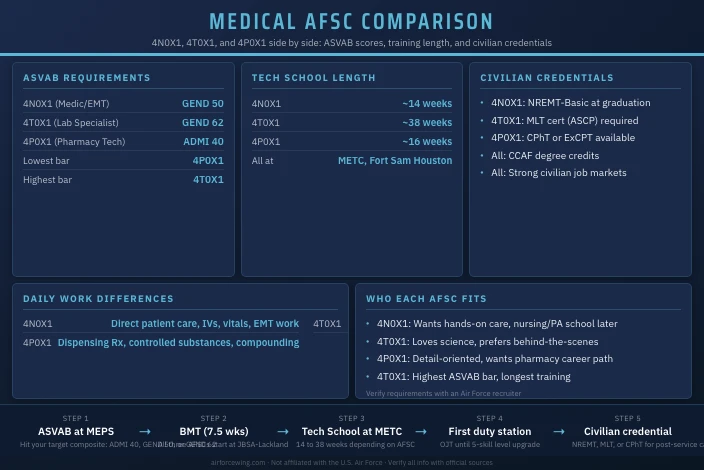
What You’ll Do Each Day
The biggest difference between these three AFSCs isn’t the credentials. It’s where you stand and who you’re talking to.
4N0X1 Aerospace Medical Technicians spend their shifts with patients directly. You’re taking vitals, drawing blood, starting IVs, administering immunizations, removing sutures, and rotating through urgent care, flight medicine, and aeromedical evacuation units. It’s the Air Force’s broadest clinical job. Some technicians specialize into shredouts like the Independent Duty Medical Technician (IDMT), which means working as the primary medical authority at remote sites with limited physician backup.
4T0X1 Medical Laboratory Specialists almost never see patients. You work in the lab processing the specimens that arrive from the clinic floors. A typical shift involves running complete blood counts, performing urinalysis, culturing microbiology specimens, and managing blood bank compatibility testing. Physicians wait on your results to make treatment decisions. The work is methodical and technically demanding, and you do it behind the scenes.
4P0X1 Pharmacy Technicians occupy the middle ground. You interact with patients at the dispensing counter, but those interactions are brief and focused. Most of the shift involves receiving prescription orders from providers, verifying drug interactions, managing controlled substance records, and preparing sterile IV preparations in a cleanroom. Precision and accountability drive everything. An error in the controlled substance safe is not a paperwork problem. It’s a legal one.
Head-to-Head Comparison
| Factor | 4N0X1 | 4T0X1 | 4P0X1 |
|---|---|---|---|
| ASVAB Composite | GEND 50 | GEND 62 | ADMI 40 |
| Tech School Length | ~14 weeks | ~38 weeks | ~16 weeks |
| Tech School Location | METC, Fort Sam Houston | METC, Fort Sam Houston | METC, Fort Sam Houston |
| Daily Work | Direct patient care | Lab diagnostics, no bedside | Dispensing, compounding, controlled substance management |
| Civilian Credential | NREMT-Basic (at graduation) | MLT certification (ASCP, required) | CPhT or ExCPT (available during service) |
| Color Vision | Required | Required | Required |
| Deployment Frequency | Moderate | Moderate | Moderate |
| Patient Contact | High | None to minimal | Low to moderate |
ASVAB Score Requirements
The three AFSCs use two different Air Force composites, and neither is the same as the AFQT overall score.
4N0X1 requires a GEND 50 (General composite). GEND combines Word Knowledge, Paragraph Comprehension, Arithmetic Reasoning, and Mathematics Knowledge. A score of 50 is achievable with solid reading and math preparation. It’s the middle threshold of the three.
4T0X1 requires a GEND 62 on the same composite. That’s the highest bar of the group, and for good reason. Lab science requires the ability to follow complex protocols, apply analytical reasoning to instrument outputs, and catch errors before results leave the lab. If you score well in science and math, this score is reachable. If math is your weak point, focused prep is worth the effort before you test.
4P0X1 requires an ADMI 40 (Administrative composite). ADMI draws from General Science, Paragraph Comprehension, Word Knowledge, and Arithmetic Reasoning. This is the most accessible entry point of the three. The job still demands precision and pharmaceutical math, but the ASVAB bar is lower than 4N0X1 or 4T0X1.
The Air Force ASVAB composite formulas are different from the Army and other branches. GEND and ADMI are Air Force-specific composites. Confirm your qualifying score with a recruiter before selecting any AFSC.
All three require normal color vision. That’s tested at MEPS and is non-negotiable. 4P0X1 also requires a typing speed of at least 25 words per minute for electronic health record work.
Training Pipeline
Every enlisted Airman starts at BMT (Basic Military Training) at Joint Base San Antonio-Lackland for 7.5 weeks. That part doesn’t change regardless of AFSC. The differences begin at Tech School.
All three career fields train at the Medical Education and Training Campus (METC) at Fort Sam Houston in San Antonio. You’ll be on the same campus as Army and Navy medical students in many courses. What separates the three is how long you stay.
4N0X1 is approximately 14 weeks (98 days) of clinical nursing skills: anatomy, pharmacology, patient assessment, IV placement, phlebotomy, wound care, and aeromedical concepts. You graduate with NREMT-Basic certification, which is recognized for civilian EMS employment in most states.
4T0X1 is approximately 38 weeks (268 days) of laboratory science. This is one of the longest Tech Schools in the enlisted medical field. The curriculum covers hematology, urinalysis, clinical chemistry, microbiology, blood bank, and immunology. Before you can be promoted past E-4 and earn your 5-skill level, you must pass the MLT (Medical Laboratory Technician) certification from the American Society for Clinical Pathology (ASCP). That certification is mandatory, not optional.
4P0X1 is approximately 16 weeks (110 days) covering pharmaceutical calculations, pharmacology, dispensing procedures, sterile compounding technique, and controlled substance regulations. You don’t graduate with a certification automatically, but ExCPT and CPhT certification through PTCB are available during service. Many technicians pursue both.
All three AFSCs earn credits toward a Community College of the Air Force (CCAF) associate degree tied to their specialty.
Civilian Career Paths
The credential you leave with affects your day-one job options after separation. Here’s what each AFSC realistically leads to.
4N0X1 graduates with NREMT-Basic, which opens EMS employment immediately. Technicians who earn the Paramedic shredout (4N0X1H) during service exit with EMT-Paramedic credentials, which significantly increases earning potential. The clinical experience from a four-year enlistment is viewed favorably by nursing programs, physician assistant schools, and pre-medical advisors. Many post-service schools count 4N0X1 experience toward clinical hour requirements.
4T0X1 leads directly to clinical laboratory technician or technologist positions in hospitals, reference labs, and public health facilities. The MLT credential you earn in service is nationally recognized with no additional training required to start working. Technicians who pursue a bachelor’s degree can bridge to the MT (Medical Technologist) certification, which increases salary considerably. BLS data puts median wages for clinical laboratory technicians around $54,000, with technologists closer to $62,000.
4P0X1 points toward pharmacy technician roles in retail, hospital, and specialty compounding pharmacy settings. BLS data shows a median wage of $43,460 for pharmacy technicians with a faster-than-average job growth projection through 2034. Technicians with sterile compounding and USP 797/800 training from inpatient MTF assignments are competitive for higher-paying hospital pharmacy positions. The PharmD pathway is also realistic for technicians who complete prerequisites during service.
Deployment and Operational Reality
None of these three AFSCs are combat roles. All three are deployable. The differences in tempo are more about unit assignment than AFSC itself.
4N0X1 Airmen deploy to support Air Expeditionary Force medical units, and those with the aeromedical evacuation shredout (4N0X1G) deploy more frequently because their mission is patient movement from theater to definitive care. Most 4N0X1 Airmen can expect one deployment in a four-to-six-year enlistment. 4T0X1 and 4P0X1 both embed in Air Force Expeditionary Medical Support (EMEDS) packages that deploy to contingency locations. Typical rotation lengths run 90 to 180 days across all three career fields.
Airmen assigned to high-EMEDS-rotation units will deploy more often than those at large fixed medical centers. If deployment frequency is a major factor in your decision, ask the recruiter which specific unit you’d be assigned to, not just the AFSC.
Which AFSC Fits You
Each of these three jobs selects for a different type of person.
Choose 4N0X1 if you want direct patient interaction from day one, you’re considering nursing, PA, or pre-medicine after service, or you want the broadest possible clinical exposure. The NREMT at graduation is a real credential with immediate value, and the shredout options are the most varied in the medical career field.
Choose 4T0X1 if you scored well in science and math, you prefer analytical precision over bedside care, and you want a civilian credential that maps to a specific in-demand job title. The nine-month Tech School is a long commitment, but the MLT certification you earn is worth it for anyone serious about a laboratory science career.
Choose 4P0X1 if you want the most accessible ASVAB threshold of the three, you’re detail-oriented and comfortable with legal accountability for controlled substance management, and you want a clear civilian path in pharmacy or related healthcare fields. The work is structured and predictable, which suits people who want defined hours over the variability of clinical care.
This site is not affiliated with the U.S. Air Force or any government agency. Verify all ASVAB score requirements, training seat availability, and bonus eligibility with an official Air Force recruiter before making any enlistment decisions.
For a deeper look at all healthcare AFSC options, the Air Force medical careers section profiles each specialty with full qualification tables and training pipeline details. You may also find the Air Force Medical AFSC Jobs: Complete Guide and Air Force ASVAB test prep guide helpful as you narrow down your options.