1N0X1 vs 1N1X1 vs 1N2X1: Which Intel AFSC
Three Air Force intelligence AFSCs dominate the enlisted career field, and they sound similar enough that most recruits can’t immediately explain how they differ. All three require a Top Secret/SCI clearance. All three run through Goodfellow AFB for tech school. All three can hand you a cleared civilian career worth six figures on the way out the door. But the daily work, the ASVAB score you need, and the civilian market you enter are genuinely different across 1N0X1, 1N1X1, and 1N2X1.
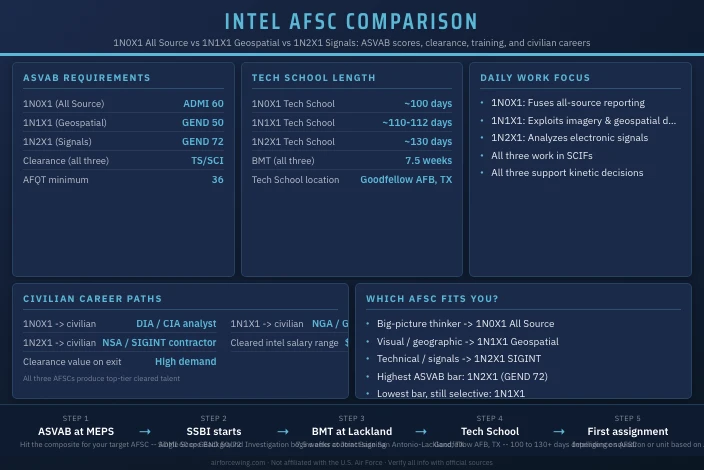
Quick Comparison
The table below puts the key facts in one place before diving into the details.
| Factor | 1N0X1 All Source | 1N1X1 Geospatial | 1N2X1 Signals |
|---|---|---|---|
| ASVAB composite | ADMI 60 | GEND 50 | GEND 72 |
| Core data type | All-source reporting | Imagery and maps | Electronic signals |
| Tech school length | ~100 days | ~110-112 days | ~130 days |
| Tech school location | Goodfellow AFB, TX | Goodfellow AFB, TX | Goodfellow AFB, TX |
| Clearance required | TS/SCI | TS/SCI | TS/SCI |
| Deployment frequency | Moderate | Moderate | Moderate to high |
| Civilian track | DIA, CIA, defense intel | NGA, GIS contractors | NSA, SIGINT contractors |
All three require U.S. citizenship. All three begin at BMT at Joint Base San Antonio-Lackland before moving to tech school.
1N0X1: All Source Intelligence Analyst
1N0X1 is the generalist. These analysts take intelligence reporting from every available collection source, signals, imagery, human intelligence, open-source data, and turn it into a single finished product. Instead of being an expert on one data type, All Source analysts are responsible for the big picture.
What the job actually looks like
On any given shift, a 1N0X1 analyst might be writing a threat assessment, preparing a commander’s brief, or correlating reporting from three different collection disciplines to answer a specific intelligence question. The work is writing-heavy and judgment-intensive. You’re producing documents that decision-makers read and act on.
Daily tasks typically include:
- Reviewing incoming intelligence reports from multiple collection sources
- Producing finished assessments, briefings, and intelligence summaries
- Identifying information gaps and recommending collection requirements
- Supporting strike planning, route analysis, and force protection decisions
- Briefing commanders and intelligence officers at all levels
This is the AFSC for analytical writers who want the broadest possible view of the intelligence picture.
ASVAB composite
1N0X1 is the only major intel AFSC that does not use the GEND composite. It requires the ADMI (Administrative) composite at a minimum score of 60.
ADMI = General Science + Paragraph Comprehension + Word Knowledge + Arithmetic Reasoning
The verbal emphasis is similar to GEND, but General Science replaces Mathematics Knowledge. Candidates who score well on vocabulary and comprehension but find advanced math harder should pay attention to that distinction.
Training
Tech school runs approximately 100 days at Goodfellow AFB. The course covers intelligence collection disciplines, report writing, analytical tradecraft, and the systems used to access and produce intelligence products. At the end of tech school, graduates earn Basic Intelligence Analyst certification before moving to their first assignment.
Civilian career path
The clearance plus all-source experience maps directly to analyst positions at the Defense Intelligence Agency (DIA), CIA, State Department, and major defense contractors. Cleared all-source analysts with four to six years of service routinely transition into roles paying $80,000 to $110,000+ depending on contractor and location.
1N1X1: Geospatial Intelligence Analyst
1N1X1 is the imagery and mapping specialist. Geospatial analysts work with data collected by satellites, unmanned aircraft, and manned reconnaissance platforms. The raw material is visual, photos, video, radar images of the Earth’s surface. The product is intelligence about what those images mean.
What the job actually looks like
An imagery analyst on shift might be measuring a building’s dimensions for a targeting brief, assessing post-strike damage from the night before, or building a terrain analysis for a special operations team planning an entry route.
Core daily tasks include:
- Analyzing multi-spectral, electro-optical, and radar imagery
- Extracting target coordinates using mensuration techniques
- Assessing battle damage from post-strike imagery
- Producing geospatial products and standardized intelligence reports
- Supporting flight planning with terrain and obstacle analysis
The work requires patience with detail and a visual analytical mindset. Long shifts of focused screen work are standard.
ASVAB composite
1N1X1 uses the GEND (General) composite with a minimum score of 50: the lowest threshold in the intel career field.
GEND = Word Knowledge + Paragraph Comprehension + Arithmetic Reasoning + Mathematics Knowledge
The lower bar doesn’t mean easier selection overall. The clearance investigation alone screens out a significant portion of applicants, and available billets limit how many recruits the Air Force actually takes each year.
Training
Tech school runs approximately 110 to 112 days at Goodfellow AFB. Students learn imagery exploitation software, mensuration techniques, geospatial product standards, and the legal framework governing imagery collection. Graduates leave with skills that directly match civilian GIS and GEOINT positions.
Civilian career path
The 1N1X1 clearance and skills feed directly into the National Geospatial-Intelligence Agency (NGA), commercial satellite companies, and defense contractors supporting geospatial programs. Cleared GIS specialists earn $80,000 to $130,000+ depending on experience and clearance level. The GIS Professional (GISP) certification and NGA-aligned graduate certificate programs are natural follow-on credentials after service.
1N2X1: Signals Intelligence Analyst
1N2X1 is the most technically demanding of the three. Signals Intelligence analysts work with electronic emissions, radar signals, communication systems, electronic devices, and analyze what those signals reveal about adversary capabilities and intentions. The data is invisible; the analysis requires understanding how electronic systems behave.
What the job actually looks like
SIGINT analysts work with collection systems that intercept radar emissions, communication signals, and electronic activity from adversary systems. They characterize the signals, compare them against known signatures, and produce reports that inform assessments of foreign military capabilities.
Daily tasks typically include:
- Collecting and analyzing electronic signals from radar and communications systems
- Characterizing signal parameters against threat libraries
- Producing technical and operational intelligence reports
- Identifying new or modified electronic systems based on signal behavior
- Supporting targeting and electronic warfare planning
This AFSC suits people who think in technical terms, frequency, waveform, electronic systems behavior, rather than in visual or textual terms.
ASVAB composite
1N2X1 uses the GEND composite with a minimum score of 72: one of the highest enlisted ASVAB thresholds across the entire Air Force, not just in the intelligence career field.
That threshold is not arbitrary. SIGINT work requires genuine technical reasoning ability. Candidates who struggle with Arithmetic Reasoning or Mathematics Knowledge will find the material difficult beyond just qualifying.
Training
Tech school runs approximately 130 days at Goodfellow AFB. The curriculum is more technically dense than the other two AFSCs, covering electronic signal fundamentals, collection systems operation, reporting formats, and the specialized tradecraft of signals analysis. Some specialties within the 1N2X1 field require additional training pipelines after initial qualification.
Civilian career path
SIGINT experience is among the most valued credentials in the cleared community. The National Security Agency (NSA) is the primary civilian employer, alongside defense contractors supporting NSA and combatant command SIGINT programs. Cleared SIGINT analysts with technical depth routinely transition into roles at $90,000 to $130,000+ depending on specialization.
Side-by-Side: Key Differences
The three AFSCs differ most clearly on two axes: what kind of data you work with, and how technically demanding the entry bar is.
Data type and analytical style:
- 1N0X1 analysts work with text, reports, and multi-source summaries. The job rewards strong writing and synthesis.
- 1N1X1 analysts work with images and spatial data. The job rewards visual attention to detail and geographic thinking.
- 1N2X1 analysts work with electronic signals. The job rewards technical reasoning and systems-level thinking.
ASVAB score gap:
The spread from the lowest (GEND 50 for 1N1X1) to the highest (GEND 72 for 1N2X1) is 22 points on the same composite. That’s a meaningful difference in preparation time for most recruits. A candidate who scores 65 on GEND qualifies for 1N0X1 and 1N1X1 but falls short of 1N2X1.
Deployment tempo:
All three AFSCs deploy in support of combatant command requirements. Typical deployment lengths run 90 to 180 days. SIGINT units supporting active operations can run higher tempo than the other two fields, but tempo varies significantly by unit and assignment.
Clearance Process: What All Three Require
All three AFSCs require a Top Secret clearance with SCI eligibility. That means a Single Scope Background Investigation (SSBI) before you begin tech school.
The investigation covers your financial history, foreign contacts, prior drug use, criminal record, and personal associations. Disqualifying factors include:
- Significant foreign contacts or dual citizenship issues
- Recent drug use (marijuana included, despite state-level laws)
- Unresolved financial problems such as heavy debt or bankruptcy
- Criminal history involving dishonesty or violence
- Deliberately withholding information during the investigation
The investigation can take anywhere from a few months to over a year. Your recruiter will initiate it after you sign your contract. Being honest throughout the process matters. Adjudicators evaluate honesty alongside the underlying issue, an undisclosed problem is often treated more seriously than a disclosed one.
All three AFSCs require TS/SCI eligibility. No prior drug use is a firm requirement across the intelligence career field. Any disqualifying history should be discussed with your recruiter before you select an AFSC.
Which One Fits You
The right choice depends on how you think, not just what score you can hit.
Choose 1N0X1 if you’re a strong writer and analytical thinker who wants the broadest intelligence picture. The ADMI composite rewards verbal ability over technical math. The job involves producing finished written products and briefing senior leaders. Post-service, you’re aiming at traditional intelligence analyst roles across the community.
Choose 1N1X1 if you think visually and find geography or satellite imagery genuinely interesting. The lower ASVAB bar makes it more accessible, but the job still demands precision and sustained focus during imagery exploitation sessions. Post-service, you’re aiming at the geospatial sector. NGA, commercial satellite, and GIS contracting.
Choose 1N2X1 if you have a technical mindset and can hit the GEND 72 threshold. The training is longer, the material is more demanding, and the post-service ceiling is higher for people who invest in the technical specialization. NSA and SIGINT contractor roles are consistently among the best-compensating positions in the cleared community.
If your score currently falls below the 1N2X1 minimum, it’s worth studying for a retake before making a final decision. The difference between a GEND 65 and GEND 72 is achievable with targeted prep on the Arithmetic Reasoning and Mathematics Knowledge subtests.
All three AFSCs draw from GEND or ADMI composites. Focused prep on Word Knowledge, Paragraph Comprehension, Arithmetic Reasoning, and Mathematics Knowledge covers the overlap. An ASVAB prep course with practice tests on those specific subtests is the most efficient path for most candidates.
This site is not affiliated with the U.S. Air Force or any government agency. Verify all information with official Air Force sources before making enlistment or career decisions.
For a deeper look at the full intelligence career field including 1N3X1, 1N4X1, and 1N8X1, see the Air Force intelligence and cyber AFSC guide. A full breakdown of ASVAB line score requirements across all six intel AFSCs is at Best ASVAB Scores for Intelligence AFSC Jobs. When you’re ready to explore assignment options, Air Force intelligence careers covers every 1N AFSC in the enlisted career field.