1C1X1 Air Traffic Control: What It's Really Like
Air Force air traffic controllers earn FAA certification as part of military training, hold a federal credential from day one, and exit service into one of the most in-demand civilian jobs in aviation. But the pipeline is demanding, the shift work is constant, and the wash-out risk during on-the-job qualification is real. Here’s what the job actually looks like from entry to career.
This site is not affiliated with the U.S. Air Force or any government agency. Verify all information with official Air Force sources before making enlistment or career decisions.
A Day in the Life of an Air Force Controller
There is no single “typical day” in 1C1X1. The work changes depending on which position you’re assigned to and whether you’re working a busy flying day or a quiet Sunday morning.
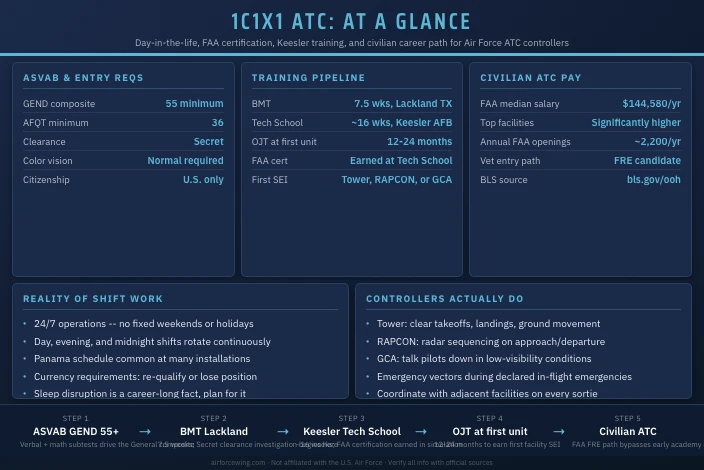
Controllers split their time across three types of facilities. Tower controllers have eyes on the runway. They clear aircraft for takeoff and landing, manage ground movement, and handle the radio chatter from a glass-enclosed cab perched above the airfield. RAPCON controllers work in windowless rooms lit by radar scopes, sequencing arrivals and departures during approach and departure phases. GCA controllers use precision approach radar to talk pilots down to the runway when visibility drops.
A busy shift at a fighter base sounds like this: multiple radio frequencies active, several aircraft in the pattern simultaneously, weather updates flowing in, and a pilot calling to declare an emergency. The controller on position handles all of it in real time, on the radio, with documentation happening in parallel.
Quieter shifts exist too. A slow Thursday morning at a smaller installation might mean low traffic, routine coordination calls with adjacent facilities, and time to review NOTAMs between transmissions. But “quiet” is never guaranteed, and a controller who loses situational awareness during a slow period creates the same risk as one overwhelmed by heavy traffic.
A standard shift at most facilities looks like this:
- Pre-shift briefing: weather, NOTAMs, special flight operations, equipment status
- Position relief: you take the frequency from the outgoing controller and confirm all traffic
- On-position: active aircraft management, radio calls, radar monitoring, coordination
- Break rotation: facilities rotate controllers off live positions for required breaks
- Post-position: logs, position documentation, incident reports if applicable
Controllers rotate through positions during a shift rather than sitting on one frequency for eight hours. The cognitive demand is high on position and lower off it. Over time, that rhythm becomes the job.
Getting In: ASVAB Requirements
The GEND composite is what qualifies you for 1C1X1. The minimum is 55. GEND is built from Word Knowledge, Paragraph Comprehension, Arithmetic Reasoning, and Mathematics Knowledge, the four verbal and arithmetic subtests on the ASVAB.
The GEND floor of 55 is not the hardest threshold in the operations group, but it sits above the minimum for many other enlisted AFSCs. Controllers who score significantly above the floor tend to move faster through tech school simulation scenarios and OJT certification.
Two other requirements stop more applicants than the ASVAB does. First, color vision must be normal with no waiver available, colorblindness is disqualifying outright. Second, speech must be clear and distinct in English, assessed during the MEPS physical. Both of those screens happen before ASVAB scores matter. Check your color vision before you spend time building your GEND score.
| Requirement | Standard |
|---|---|
| GEND composite | 55 minimum |
| AFQT minimum | 36 (HS diploma) |
| Citizenship | U.S. citizen |
| Color vision | Normal, no waiver |
| Security clearance | Secret |
If the GEND composite is your bottleneck, the verbal subtests are where most points are recovered fastest. Air Force ASVAB test prep covers the Word Knowledge and Paragraph Comprehension sections in detail, those two drive roughly half the GEND formula.
Training: Keesler AFB and the OJT Pipeline
Every enlisted Airman starts at JBSA-Lackland, TX for 7.5 weeks of Basic Military Training. After BMT, 1C1X1 trainees move to Keesler AFB, Mississippi for technical school.
Tech school runs approximately 16 weeks. The curriculum covers FAA regulations, ATC principles, radar operation, emergency procedures, and standard phraseology. The final phase involves simulation exercises where trainees manage virtual aircraft in increasingly complex scenarios. Students who struggle with the simulations may be counseled into a different AFSC before the program ends. That isn’t a threat, it’s how the Air Force filters for the skills the job actually requires.
The part most candidates underestimate is what happens after graduation.
Leaving Keesler with your tech school certificate does not make you a working controller. You arrive at your first duty station as an Apprentice (3-skill level) and begin on-the-job training toward your first Special Experience Identifier (SEI). Earning an SEI. Tower, RAPCON, or GCA, requires supervised performance evaluations, written exams, and sign-off from a certified controller. That process typically runs 12 to 24 months.
One piece of planning advice: security clearance investigations can delay your tech school start date. Ask your recruiter for realistic timelines based on your background.
The Shift Work Reality
Controllers work around the clock because aircraft operate around the clock. There is no version of this career field where you keep regular business hours.
Most ATC facilities rotate through day, evening, and midnight shifts on a recurring pattern. Some installations use the Panama schedule: a rotation of 12-hour shifts that gives longer stretches of consecutive days off but requires working through nights and weekends on a regular cycle. The exact pattern depends on the installation and facility type.
What that means practically:
- Holidays fall on your duty schedule with some regularity
- Family dinners, kids’ events, and weekends are not reliably available
- Sleep patterns shift with the schedule, and midnight shifts affect sleep quality for the duration of that rotation
- Currency requirements mean you cannot step away from the facility for extended periods without re-qualifying
Controllers who thrive in this environment are the ones who plan around it rather than against it. Families that do well in ATC households tend to be adaptable and self-sufficient when a controller is on a rough rotation.
The cognitive load also follows you home in a different way. Being on a live position for two hours of dense traffic takes real mental energy. Some controllers find that the off days feel meaningfully different from jobs with predictable schedules, you’re genuinely recovered on off days after a good stretch. Others find the schedule wears on them over a career. Both are honest outcomes.
FAA Certification and the Civilian Path
The civilian value of 1C1X1 is real and direct. The FAA certification earned during military training is recognized in the civilian hiring process, and veterans with military ATC experience enter as Facility Rating Experience (FRE) candidates: a designation that bypasses some early training requirements at civilian facilities and accelerates the certification timeline.
FAA air traffic controllers earn a median annual wage of $144,580 (BLS, May 2024). Controllers at high-complexity facilities, large TRACONs and Air Route Traffic Control Centers, typically earn more. The BLS projects approximately 2,200 job openings annually through 2034, driven largely by retirements from an aging controller workforce.
The mandatory FAA retirement age for controllers is 56. A veteran who separates after a standard four-year enlistment has time to complete a full second career as a civilian controller before that cutoff. Many Air National Guard controllers do exactly this, working a civilian FAA position as their primary job while maintaining military certification on drill weekends.
Beyond the FAA, military ATC experience also feeds into:
- Aviation safety inspector roles at the FAA
- Defense contractor positions supporting ATC system upgrades and modernization
- Airline operations center jobs that value real-time airspace experience
- Airport operations management roles at civilian airports
The civilian path is not automatic. The FAA still requires academy completion and facility-level certification. But veterans enter that pipeline ahead of applicants who have no background in aircraft separation, phraseology, or radar.
Who Fits This Job
The ASVAB screen exists for a reason. This job favors people who process information fast, speak clearly under pressure, and stay methodical when multiple things compete for attention simultaneously.
If you freeze when too many things happen at once, that tendency will surface in the simulation phase at Keesler or during OJT. The certification structure is designed to catch it before a real aircraft is involved. That’s not a moral judgment, it’s a job match question.
Strong indicators this is a good fit:
- You score well on verbal and arithmetic reasoning, not just overall AFQT
- Aviation genuinely interests you as a subject, not just as a career label
- You adapt to irregular schedules rather than resenting them
- Real-time performance feedback doesn’t destabilize you
Strong indicators it may not fit:
- Color vision deficiency (disqualifying, no waiver)
- Medical conditions affecting sustained attention or sleep
- A strong preference for predictable weekends and evenings
- Anxiety about high-stakes evaluations that happen in real time
The wash-out risk during OJT is real enough to take seriously. Controllers who enter the pipeline without genuine interest in the work, or who expect the pace to ease up, sometimes find themselves reclassified before they earn their first SEI. Researching the job before listing it as your top AFSC preference is time well spent.
Civilian Pay vs. Military Pay
Military pay follows the DFAS schedule by grade and years of service. The figures below reflect 2026 rates.
| Rank | Grade | Entry Pay | 4 Years |
|---|---|---|---|
| Airman First Class | E-3 | $2,837/mo | $3,198/mo |
| Senior Airman | E-4 | $3,142/mo | $3,659/mo |
| Staff Sergeant | E-5 | $3,343/mo | $3,947/mo |
| Technical Sergeant | E-6 | $3,401/mo | $4,069/mo |
Basic pay does not capture total compensation. Airmen not living in barracks receive BAH (varies by installation and dependency status) plus a flat BAS of $476.95/mo. TRICARE Prime covers medical, dental, and vision at zero out-of-pocket cost for active duty Airmen. The combination makes the effective compensation package significantly higher than basic pay alone.
The contrast with the civilian side is stark. An FAA controller at a Level 10 or higher facility earns well above the $144,580 median. A veteran separating after four to eight years of military service, with an FAA certificate already in hand, walks into that job market with credentials that most civilian applicants spend years trying to build.
You may also find Air Force Operations Jobs: ATC, Airfield Management, Weather and the full Air Force operations career group helpful for comparing 1C1X1 against the other enlisted operations AFSCs.